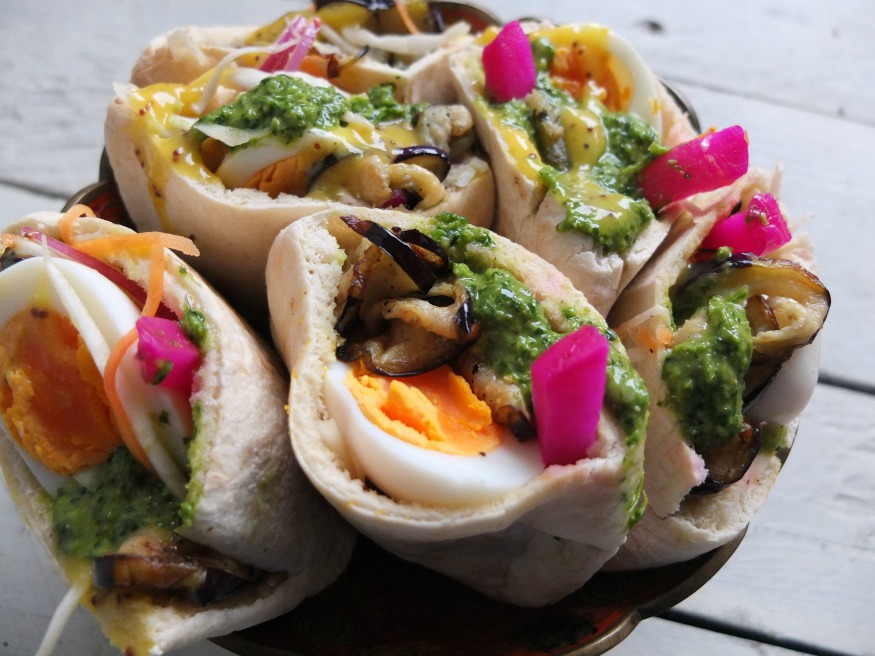
I first tasted sabich in Tel Aviv a couple of years ago. I’d become so obsessed with the idea of tasting one, in fact, I made a point of seeking out as many as possible, managing just three. That number looks a bit more impressive when you consider that I went on a mad dash around the city in the few hours I should’ve spent packing for the airport, and I was eating sabich right up until I buckled into my seat.
The sandwich starts with a soft, round proper Israeli pita, not those cardboard slippers we get in the supermarkets, which is warmed (not toasted), and split for filling. Inside you’ll find sliced potato, hard-boiled egg, fried aubergine, pickles, salads and sauces, including amba. That’s a sweet and tart sauce consisting of mangoes and spices and it basically makes the sandwich.

I’m not sure why it’s taken me so long to make one, and I think part of it was the fear of cooking from increasingly distant memories. The amba is sweet, sharp and vaguely musty, and the zhoug a lightning bolt of green, all zippy herbs and chilli heat.

I’d love to go back to Tel Aviv one day, a thrilling city with incredible food. These sandwiches are a glimmer of that sun-soaked city on a freezing afternoon in South London, and for now, that’ll do me just fine. For now.

Sabich Recipe

Makes 6 pitas with leftover amba and zhoug (a very good thing)

For the amba

Amba is a sweet and sour mango sauce which probably arrived in Israel with the Iraqi Jews and is a common topping on sabich and falafel. It really makes this sandwich.

2 unripe (green) mangoes (you should have no trouble finding these in the supermarket…), peeled and diced
5 cloves garlic, crushed or grated
1 heaped teaspoon mustard seeds
1 teaspoon ground cumin
1 large pinch turmeric
1/2 teaspoon ground fenugreek
1 tablespoon caster sugar
2 tablespoons white wine vinegar
Juice of 1 lemon
1 tablespoon vegetable or groundnut oil, for frying

In a small saucepan, gently heat the sugar with the lemon juice and vinegar, until the sugar is dissolved. Add the mango pieces along with 200ml water and simmer for 25-30 minutes, until the pieces are very soft (you will blend the sauce). In a separate, small frying pan or saucepan, heat the oil and add the mustard seeds. When they start to pop, add the garlic and cook very briefly, stirring, for 30 seconds or so. Add the turmeric, cumin, fenugreek and some salt and mix well. Transfer to a blender and whizz until smooth. Set aside to cool.

For the zhoug

Zhoug is a Yemenite chilli sauce which is fantastic with pretty much everything, including grilled meat and fish.

Large bunch of coriander and stalks
Slightly smaller bunch of parsley and stalks
5-10 green chillies (depending on their heat and your tolerance)
8 garlic cloves
1 teaspoon caraway seed
1 teaspoon cumin seeds
Juice of 1 lemon
2 large pinches of salt
2 tablespoons olive oil

In a pestle and mortar, crush the cumin and caraway seeds. Add the salt and crush the garlic too. Transfer to a food processer with the herbs, lemon juice and chillies and blend to a paste. Add the oil and blend again. Check for seasoning.

For the sandwiches

1 aubergine
3 potatoes
6 small, round, soft pita
3 eggs
1/2 small white cabbage, finely shredded
1 carrot, grated or cut into very fine strips
1/2 red onion, finely sliced
1 teaspoon olive oil
1 teaspoon white wine vinegar
Vegetable or groundnut oil, for frying

First, cook the aubergines by cutting into 1 cm slices, then frying in oil. I used a cast iron skillet for this, with oil to a depth of 1cm. Remove the slices when they are golden on each side and rest on kitchen paper.

Cook the potatoes in salted water. Drain, cool a bit and slice.

Cook the eggs by covering them with cold water. As soon as they start to boil, time them for 5-6 minutes (small-large), then transfer to a bowl of cold water. Peel and cut in half or slice.

Make a salad by mixing the cabbage, carrot, onion, olive oil, vinegar and some salt and pepper.

To assemble the sandwiches

Warm the pittas, but don’t toast them – they should be soft and pliable. Cut the top off and stuff with the ingredients and sauces. Direct into mouth.
 

Sometimes I have a conversation with people at the gym, which starts when they say something like, “why don’t you try x diet?” or “why don’t you cut carbs?” or “why don’t you reduce your intake of this?” and all the time I say, “I can’t” and they look at me like I’m making an excuse. It’s very hard to explain what I do, my love of food and the emotional significance of it, to people who are able to eliminate food groups, or drastically reduce calories. I can’t communicate how it goes against the very fibre of my being (literally) to restrict my intake of food in that way.

What I do is about more than describing what I eat, it is about how it makes me feel. It is the comfort of steam rising from a stew plopping gently on the hob, the dumplings warm and heavy on top. It’s about the sticky bun with builder’s tea when you’re frantic about the state of the world, or the slippery flick of buttered spaghetti, eaten in bed, with a hangover. It’s not even just about the joy of fat and carbs either – in January I crave bright, green vegetal things which bring freshness and vitality to a sad sack month.

I’ve often heard the phrase ‘don’t be an emotional eater’, meaning don’t comfort or reward yourself with food, and I think, ‘is there any other way?’ What is it like to look at ingredients and see calories instead of flavours? To stab letters into an app that passes judgement on what you’re about to consume, reducing it to numbers? Numbers are the worst. There is the very real problem of obesity, of course, and everything that comes with it, but that is why I bust my ass at the gym five times a week. To see food purely as fuel is such an alien concept.

This is not an anti-clean eating rant, although goodness knows I have plenty of those within me, it’s just an observation now that I’m in contact with people from another world – lovely, intelligent, fun people but with attitudes to food that are light years away from my own. I think of these conversations every time I make something I know they wouldn’t touch with a spiralizer, which brings me nicely onto this recipe for prawn toast. I live with a prawn toast obsessive – never an opportunity missed to order one of those white paper bags from the takeaway, his eager paw rustling in and out until all that’s left is grease spots.

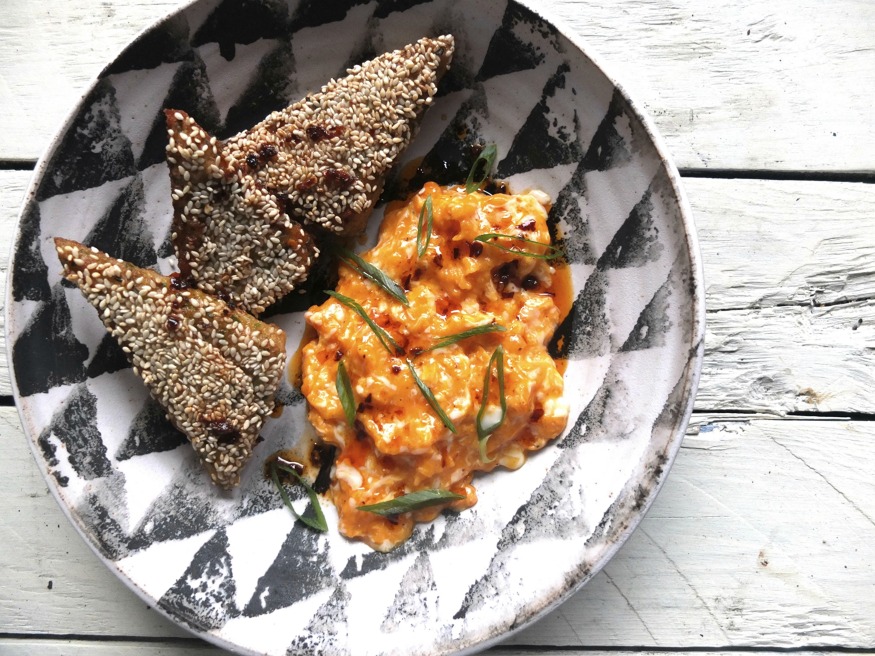
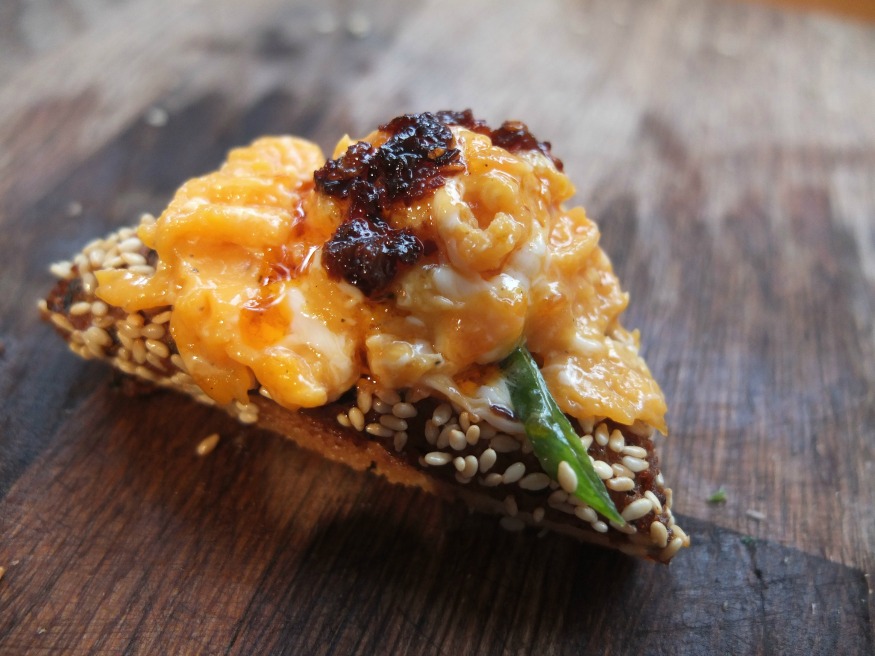
The homemade version is obviously much nicer, and we played with the mixture a bit, ramping up the prawn flavour with some shrimp paste (so good), adding garlic, spring onions and soy. It’s fantastic with scrambled egg for a really OTT brunch, and the chilli oil is crucial for counteracting all that richness. That’s right, guys, extra fat on top.

Prawn Toast with Scrambled Eggs and Chilli Oil

This makes 4 rounds and so serves 4 people (4 pieces is enough with the eggs).

250g prawns
2 cloves garlic
4 spring onions
1/2 teaspoon shrimp paste (I used a Thai one)
1 dash light soy
1 egg
4 slices cheap white bread
Oil, for frying (veg or groundnut)
Sesame seeds
Chilli oil, to serve

For the eggs

6 eggs (I used Burford Browns, hence the amazing colour)
Large chunk of butter (LARGE)

To make the prawn toast, put everything in a blender except the bread and process to a paste. Heat a frying pan and fry a tiny bit of the mixture to check for seasoning – add salt if you like. To assemble, divide the mixture between four pieces of bread, spreading in a thick layer on top. Cut the crusts off. Divide each into four triangles.

Spread sesame seeds on a plate and use them to coat the top of the toast. I found it easiest to sprinkle these on rather than dunk.

Heat oil to a depth of a couple of cm in a heavy based pan and fry each piece until golden (a couple of mins each side should do it). Set aside on a plate covered with kitchen paper. You could keep them warm in a low oven if you like.

To make the eggs, whisk them in a bowl and season. Melt the butter in a pan and add the eggs, moving them around gently until they are nearly cooked. Take them off the heat before you think they are fully done. Don’t over stir.

Serve alongside prawn toast, chilli oil on top.

My first dish of manti was a crushing disappointment. I’d developed an interest in Turkish food and was determined, on a visit to Istanbul, to tick off as many experiences as possible – always a guaranteed route to spoiling the fun. I’ve learned over the years that while planning is all well and good, you need to allow for a certain amount of spontaneity when travelling, otherwise it just turns into an exercise in box-ticking. You may as well walk around with your eyes closed.

The manti happened because we were hopelessly lost in some back street – a really steep, cobbled lane which we trudged along in the early afternoon sun, moaning and bickering because we wanted nothing more than an ice cold beer and a plate of something really, authentically Turkish. Once the flip-flops on my newly exposed feet had rubbed the skin raw and our t-shirts clung to our backs we’d had enough and ducked into the next pleasant-enough looking restaurant.

The walls were covered in colourful mosaic tiles and the staff were young and spoke English – not exactly the ‘little old lady rolling yufka’ experience I’d been hankering after but hey, when did jumping to conclusions ever get me anywhere? Also: cold beer. We saw manti on the menu and I was thrilled at the opportunity to tick something off the list. My first, real manti experience was incoming.

They were multicoloured, these dumplings (a warning sign if ever I’ve seen one), and were as bland as flour and water can be. A bowl of flabby pouches in plain yoghurt, underseasoned and sorry for themselves. I’d never tasted manti before, but I knew they had to be more than this, because as a cook, I’m able to read a list of ingredients and have a pretty good idea what the final dish is going to taste like. That was the first thing we ate in Istanbul.

Thankfully, there were many better meals that holiday but actually, no better manti. I’ve had fantastic mantu (Afghani cousins) in Adelaide, glorious khinkali in Georgia and many other dumplings around the world, but no good manti. Even those I’ve eaten in the UK have been a different style entirely, such as the marvellous beetroot and feta version at Queen’s, almost a sort of hybrid dumpling, with various whispers of Eastern Europe and the Caucasus muddling in.

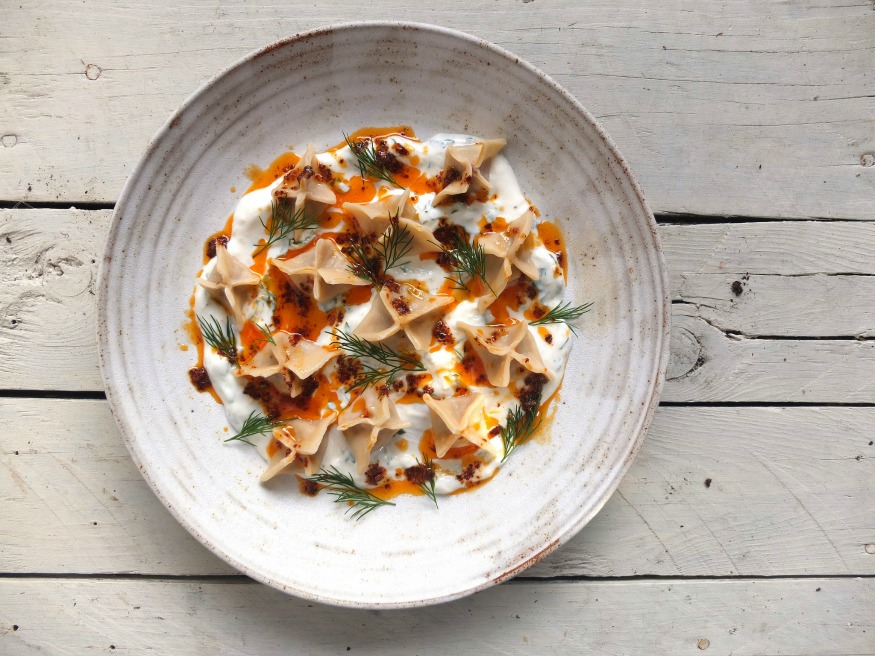
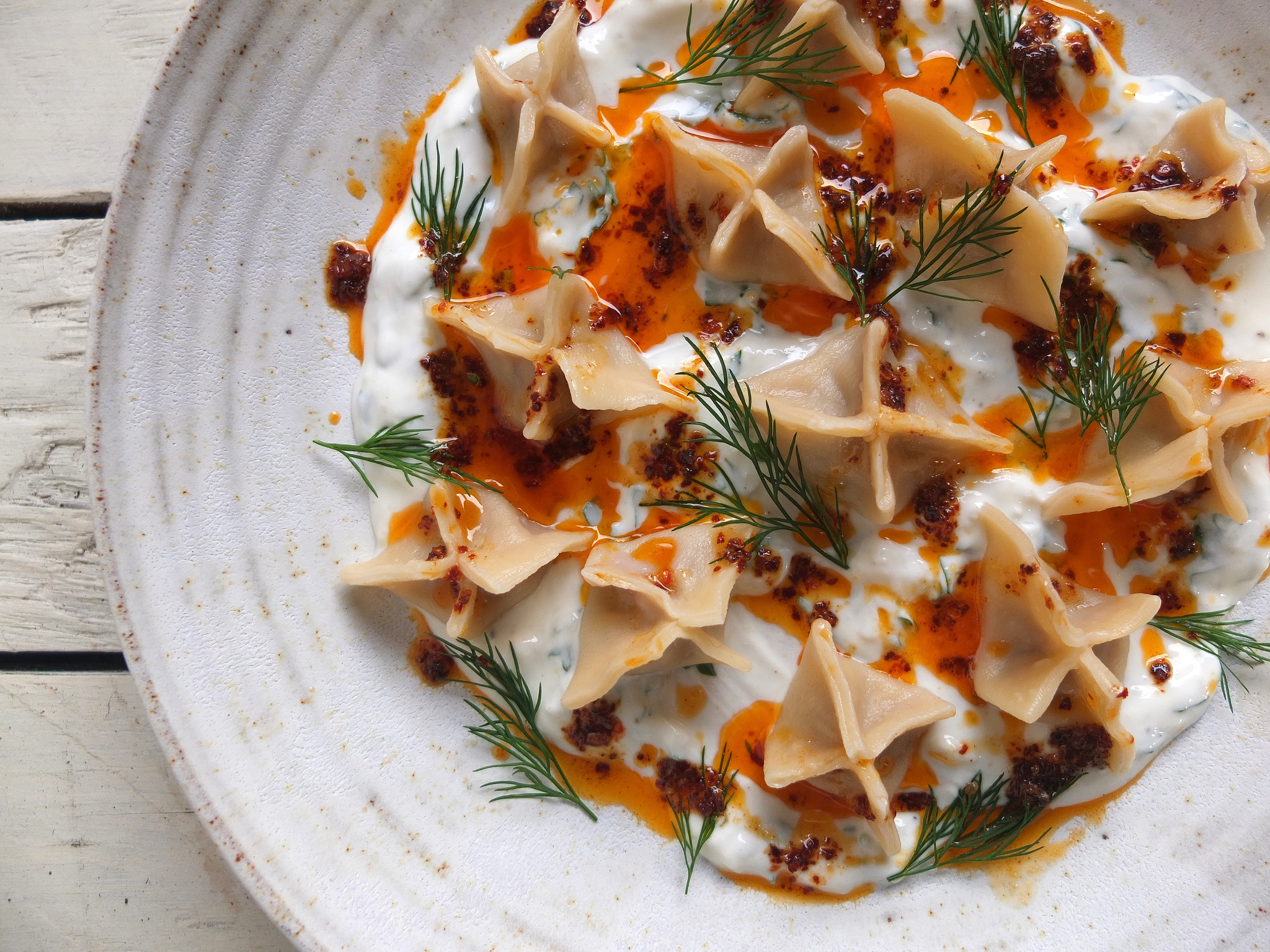
I wanted to start then, by making the very traditional Turkish lamb manti, little folded parcels containing minced meat, topped with garlic yoghurt and spiced butter. I was absolutely convinced I’d mess this up but actually they were fairly easy and I did a little dance around the kitchen when they came out exactly as I wanted them, the first time around. These are the dumplings I’d expected that day in Istanbul. The dumplings of my dreams.

Manti with Lamb, Garlic Yoghurt and Spiced Butter

This will serve 4 people in portions a little larger than the one in the photos. They’re pretty filling, to be honest.

For the dough

225 plain flour (plus extra for dusting)
1 egg
2 teaspoons olive oil
100ml cold water
Pinch salt

For the filling

150g minced lamb
½ medium onion, grated
½ teaspoon ground cumin
Pinch ground cinnamon

For the garlic yoghurt

3 cloves garlic, peeled
250g natural yoghurt (full fat, obviously)
Small handful parsley leaves

For the spiced butter

50g butter
¼ teaspoon paprika (make sure your paprika is fresh – in my experience, it’s the spice that most easily loses pungency)
1 teaspoon pul biber flakes (Turkish chilli/Aleppo pepper)

To serve
Dill

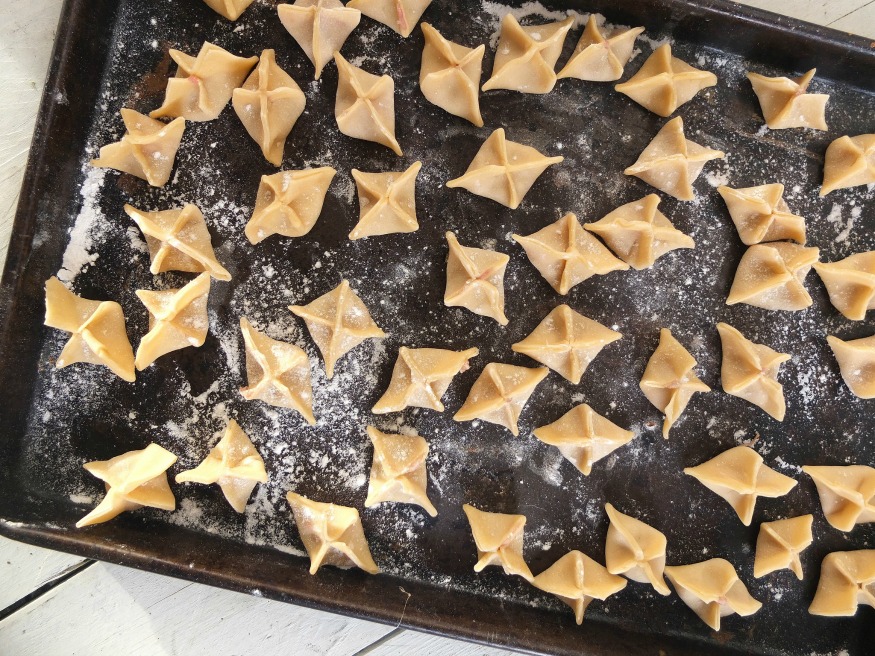
To make the dough, sift the flour and salt into a bowl, then make a well in the middle. Add the egg and olive oil and mix briefly. Add the water a bit at a time until it comes together into a dough. It shouldn’t be sticky. You might not need all the water, and I’d be surprised if you need more but flour is funny stuff – don’t worry too much. Knead on a lightly floured surface for 5 minutes or so until smooth and elastic. Divide into 4 pieces. Cover with a damp tea towel and leave for 20 minutes.
While this is happening, mix the lamb, onion, spices and some salt and pepper in a bowl, using your hands.

On a lightly floured surface, roll out one piece at a time to a width of around 2mm. This is easiest with one of those skinny rolling pins, like this (available online or in Turkish shops). Cut the dough into squares. It’s up to you but about 4cm square worked for me.

Place a blob of filling in the centre of each square, approximately the size of a chickpea. Fold opposite ends inwards and pinch together, then set the manti down, push the filling inside (it will have popped up a little) and fold the other sides to form a cross shape. This sounds complicated but is obvious once you have a go (otherwise: Youtube). Set aside on a flour-dusted tray.

Make the yoghurt by simmering the garlic cloves in boiling water for 1 minute, then draining, crushing and mixing with the yoghurt, parsley and a pinch of salt.

Make the butter by melting it and adding the spices. Heat gently, taking care not to burn it.

Cook the manti in boiling salted water for 3 minutes. Arrange on the plate with yoghurt and spiced butter. Add some dill fronds if you like. Serve immediately.

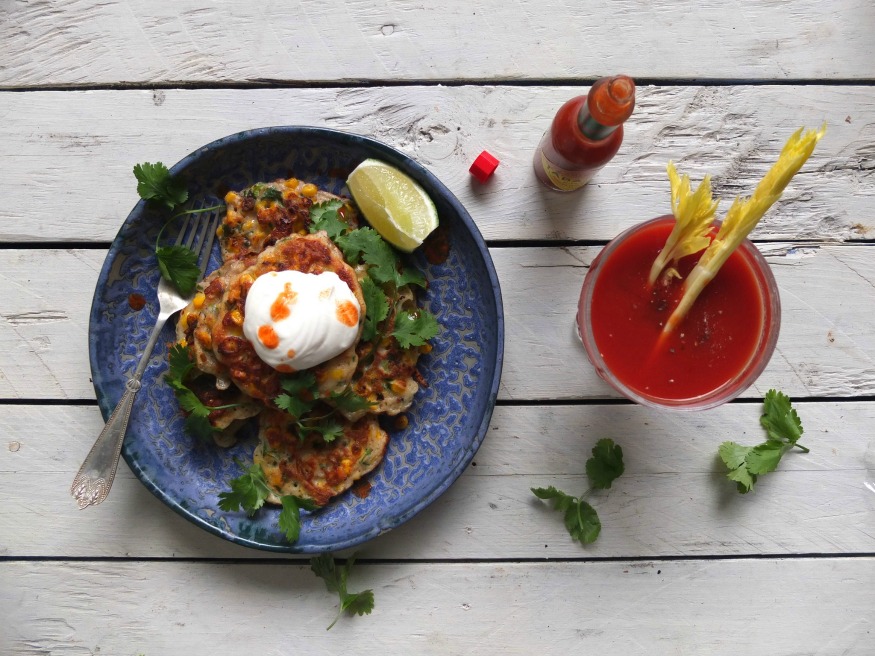
Jerk Spiced Corn Fritters

When it comes to hangovers I’m sorry to say that I have many points of reference, not that they get any easier. When once it was possible to giddily make your way out into the world after a night on the tiles, it becomes increasingly difficult to even haul your ass out of bed before midday. The still young adult starts off – dare I say it – almost enjoying a hangover, then progresses through various stages of increasing pain before reaching full-blown knuckle-dragging misery.

I have written before that taming the hangover is like dealing with a ferocious beast – you’d better tread carefully because one wrong move and it’s all over. The hangover is something that needs minute-by-minute management, and although I consider myself an expert everyone is different. I am very fussy about food, for example, to the point where things I usually adore, like eggs, cannot pass my lips post-booze. This is a recent development likely to change at any moment. I also can’t stick tea; so where usually I’m a ten cups a day gal, the morning after it’s just rancid tannic bile.

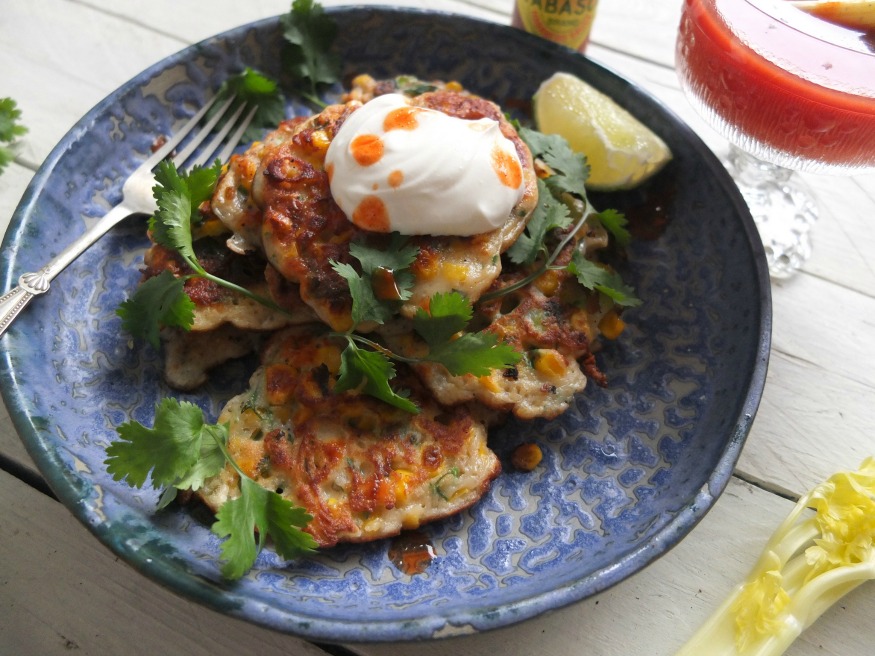
Jerk Spiced Corn Fritters

This is a recipe for a level 2-3 hangover (out of 5). I say that because it does require you to stand up in the kitchen, mix things together in a bowl and fry the results in a pan. The fritters are excellent, though, because a) they’re fried b) they’ve got corn and sour cream and c) they’ve got habanero sauce and I think we all know that it’s my absolute favourite chilli. Make these, pile them up and eat them in bed while binge-watching Netflix.

Jerk Spiced Corn Fritters with Sour Cream and Hot Sauce

This makes 15-20 fritters (depending on how large you make them)

2 x 198g cans (pre-drained weight) sweetcorn, drained
140g plain flour
¼ teaspoon baking powder
220ml milk
3 spring onions, very finely sliced
Handful coriander leaves, chopped
2 teaspoons ground allspice
1-2 teaspoons Tabasco Habanero Sauce  (remember you’ll add more at the table/in bed)
1 egg, beaten lightly with a fork
Salt
Oil, for frying (such as vegetable or groundnut)

To serve

Tabasco Habanero Sauce
Lime wedges
Sour cream
Coriander
You could also add some grilled bacon…

Sift the flour into a large bowl with the baking powder. Pour in the milk and mix well to make a smooth batter.

Add the sweetcorn, coriander, allspice, spring onion, Tabasco and egg and season with two large pinches of salt.

Heat a 1cm depth of oil in a heavy based frying pan or skillet and wait until it starts shimmering, but not smoking. Turn the heat to medium-high. Drop a tablespoon of the batter into the oil at a time and flatten it out into a round fritter shape. It will take a few minutes to turn golden on the underside – you can then flip it over and brown the other side.

Be wary as the oil will spit a little and splash as you turn them. Set aside to drain off excess oil on kitchen paper. To serve, add lime wedges, sour cream and more coriander and Tabasco alongside.

This recipe was commissioned by Tabasco. All content was written and created by me and I retain full editorial control. 


steak-slice

I am around seven years old, standing in a car park somewhere in the South of England, crying hot tears onto a cold steak slice. Standing over me is a woman with desperation in her eyes, a woman who would do anything for this strange little girl to stop making a scene and get into the car so we can leave.

It’s not my mother but someone else’s. I’m on holiday with a friend – we’ll call him John, even though he won’t read this – and it is their family holiday. I have no idea why I was so upset (maybe homesick?) but the memories are flashbulb moments of his mum leaning over me – bewildered, frustrated and at times, downright angry.

Steak slice, ready for the oven.

She had a thing about hot Ribena for the duration of this holiday or rather, her kids did. Hot Ribena is the single most disgusting beverage in the world, right up there with warm snake’s blood and coconut water. For some reason, I felt like I had to drink it anyway, that reason most likely being that I was seven years old and didn’t have the confidence or bad manners to tell her otherwise.

I remember standing in the driving rain, feeling the sickly burn combine with nausea in the pit of my stomach. There was a time when I was being particularly difficult (perhaps bawling at the prospect of another purple blackcurrant juice scalding its way down my oesophagus) and The Mum had all but given up. Enter the steak slices. I remember clearly the moment when she popped the boot of the car, pushing aside the wellies, cagoules and carrier bags to reveal a pile of Ginsters, the black and red wrappers garish, her face grimacing as she handed them out. This was a woman who used to force feed us consommé from a tin and once had a go at me for using the wrong knife on a piece of cheese. She had aspirations.

steak-slice-3

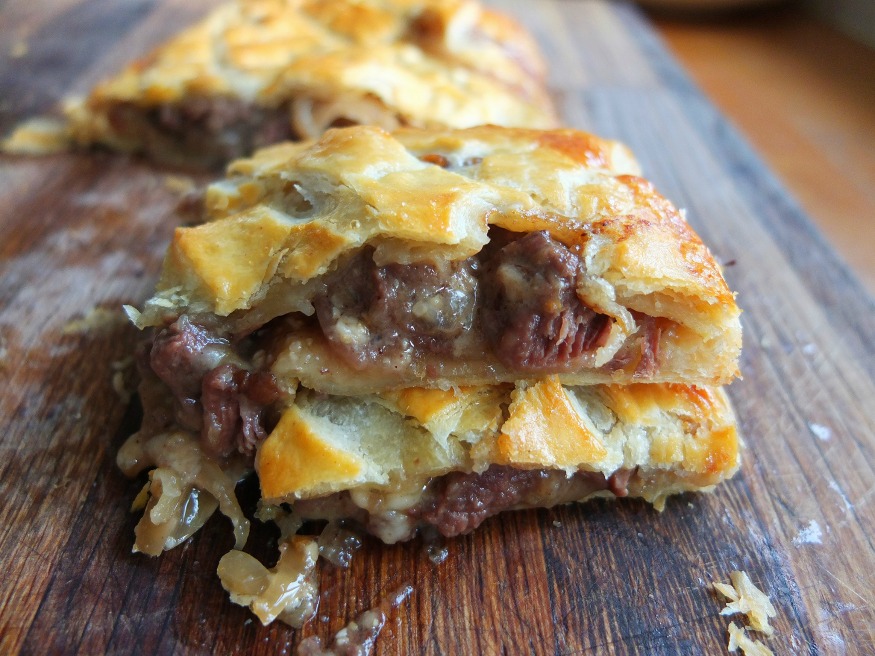
I remember her apologising for the fact there was nowhere to heat up the slices but I couldn’t have been happier. She wouldn’t believe me. I really loved a cold steak slice, see, along with a cold steak and kidney pie, or a cold cheese and onion pasty. She was giving me a huge hug from home with one hand while trying to take it away with the other. I gleefully ate it, all the wobbly peppered steak inside gummy cold pastry.

I was reminded of all this when I made these toasties because the filling, when eaten straight from the fridge, tasted just like a steak slice. It transported me instantly to the inside of a rustling raincoat, tiny red fingers clutching a packet. I had to make them. They went a little wrong because I over-filled (rookie mistake) and one burst open in the oven. Coincidentally, I did this because I was upset about something and I simply cannot cook when my mind isn’t on the job. The past few months have been stressful, which is why I had just a little taste of a freshly baked slice, before letting it cool and putting it carefully to rest in the fridge. The next day, it emerged as the perfect comfort food, no tears necessary.

Enjoyed this trip down memory lane? You may also like my Horse Meat Crispy Pancakes in the style of Findus.

Steak Slice Recipe

I tried a couple of variations on this including one with cheese and pickled onions. It was nice, but in the end I preferred just the steak filling.

1 quantity of  this steak filling (I added a handful of tiny button mushrooms too)
1 x 375g puff pastry, ready rolled (why not, eh?)
1 egg, beaten

Once the filling has been made, allow to cool and refrigerate, I left mine overnight. It needs to be completely cold and jellified otherwise it will run everywhere.

Preheat the oven to 180C.

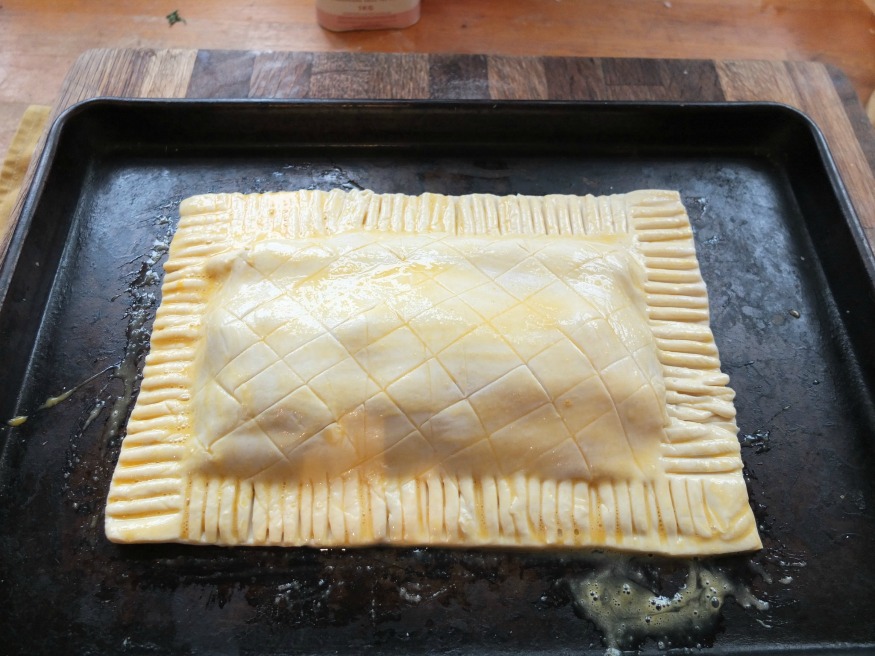
Do this next bit fairly quickly, because the pastry needs to stay cold. Cut the sheet of pastry into 4 pieces, and place two of them on a baking tray. Divide the steak slice filling between the sheets leaving a 2.5cm border (that’s a guess) around the outside and brush it with beaten egg.

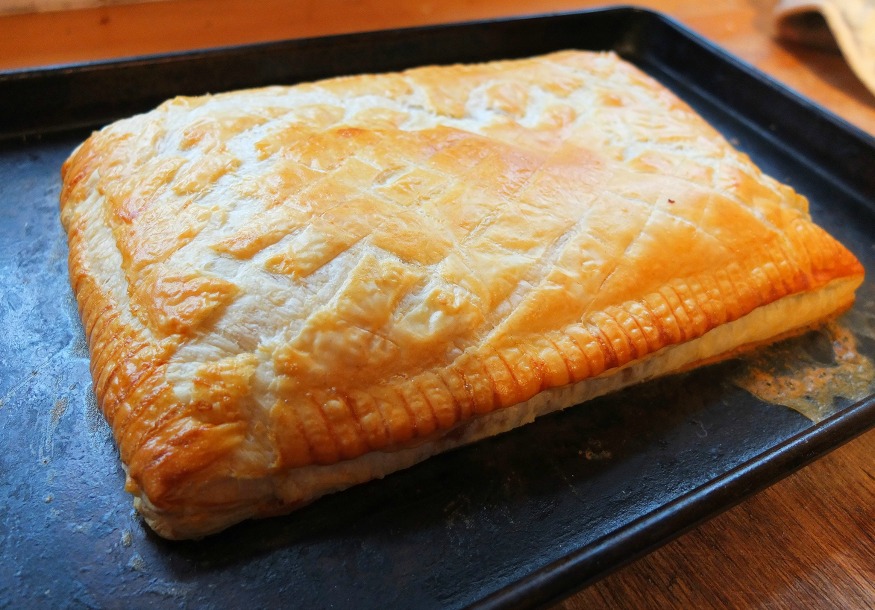
Roll out the remaining sheets of pastry so they’re slightly larger than the bases. Put them on top of the steak filling and press the edges together with a fork. Score the top if you like, using a butter knife (don’t cut all the way through). Brush the whole thing with beaten egg and cook for 20-25 mins until golden.

If you’ve got any taste at all you’ll let them go cold before eating. Maybe.

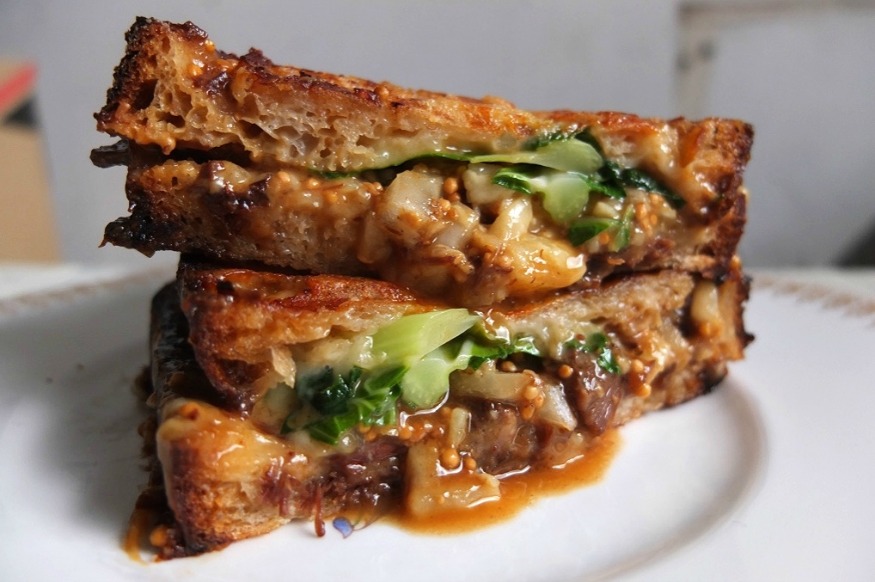
Cheese toastie with beef cheek, cauliflower leaves and pickled mustard seeds

Many of us need comfort after the events of the past week or, to be more accurate, the past year. Yes, the cheese toastie is a small thing but its cheering potential should not be underestimated; a shit tonne of melted cheese + nostalgia = a force to be reckoned with. I should, as a sandwich fanatic, own an old Breville toastie maker; I often find myself hankering for the old triangular style made with cheap white bread. Instead, I have a snazzy Heston Blumenthal contraption I was sent as a freebie but which I’ve battered through consistent heavy use. It just about works if you hold in a screw and say ‘melted cheese is the one’ three times fast while thinking about pickled onions.

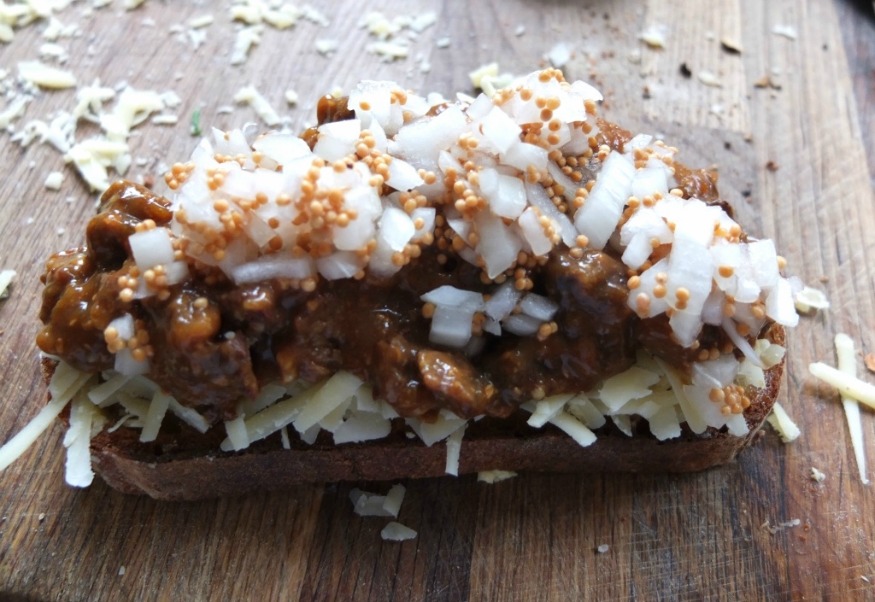
The build. Piling on half the cheese, beef and pickled mustard seeds.

There was something lovely about the simplicity of old school toasties, with their one, maybe two-item fillings. Cheese; ham and cheese; cheese and onion; cheese and tomato. We all know the dangers of hot tomato as part of the learning curve; many a child went to school with a tomato-shaped blister on their chin. Beans were also high risk. There was egg if you were being fancy (tricky to pull off).

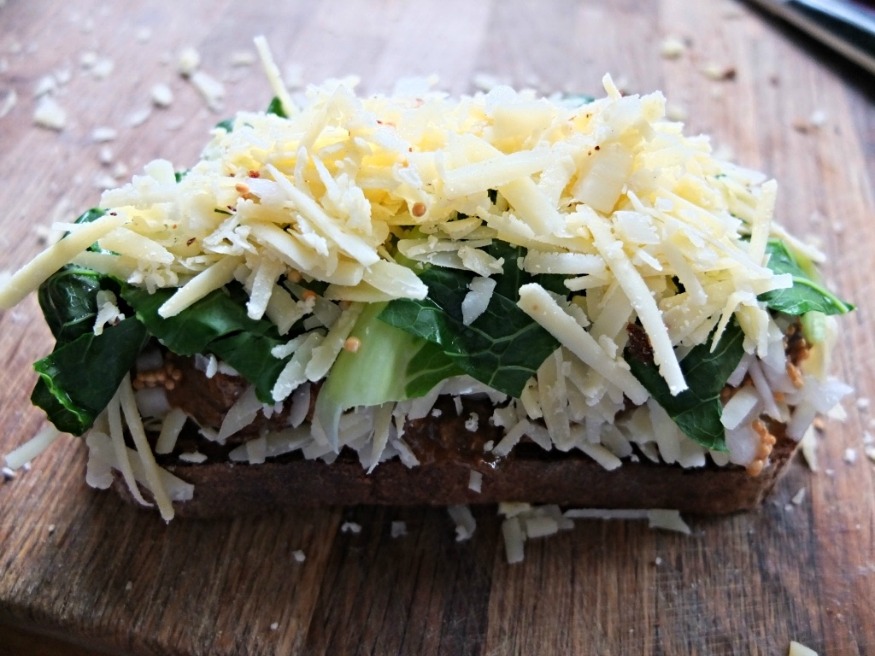
Add blanched cauliflower leaves and more cheese.

This style of toastie is still popular in pubs in Ireland, at least in Dublin, where lots will do a ‘toasted special’ – a very basic toastie which I’ve seen cooked in a normal toaster turned on its side while I waited for my pint of Guinness to settle. Cheap white bread, weird canary yellow cheese, too-thick onion. Lovely.

Toasties now are a different thing entirely – a street food trend, people’s livelihoods. We buy them from air stream trucks and restaurants for anything between £5 – £10. They contain multiple varieties of cheese (for the right balance of flavour vs. stringiness) and there are additions, like slow cooked short rib; haggis; onion and herbs; chorizo; macaroni; roast broccoli; pickles; you name it, they toast it.

I rather enjoy the way toasties have evolved, even though it took me a week to make this one. Why? Life. I forgot to buy ingredients, then I didn’t have time to slow cook the meat, then Trump… nope, still can’t deal with it.

Cheese toastie with beef cheek, cauliflower leaves and pickled mustard seeds.

So this is a thoroughly modern toastie. There is beef cheek which has been cooked slowly in a sauce given depth with red miso. There are cauliflower leaves because right now I’m enjoying them more than the florets, and there is a poky mixture of pickled mustard seeds and onion to offset the cheese. About that: it’s Isle of Mull Cheddar and Marechal. A good combination for flavour + requisite stringiness. It’s a very full-on experience, a world away from the simple toasties of childhood. The thing is, I have a lot more to worry about now. I need a comfort toastie to match.

Cheese Toastie with Beef Cheek, Cauliflower Leaves and Pickled Mustard Seeds

We made the beef stew in a pressure cooker to save time (it had been a week, after all). I use an Instant Pot in case you’re interested. The method as a whole is actually a little ridiculous now I look back over it but hey this is what we did. It tastes fantastic.

For the stock and beef cheek

1 onion, diced
500g beef cheek
2 tablespoons plain flour
2 tablespoons red miso

For the stock

Beef bones (get some from your butcher, they’ll give you enough for stock)
2 onions, roughly chopped into a few pieces
3 bay leaves
10 peppercorns
Parsley stalks

Put the beef bones in a roasting tin and roast for 30 mins at 220C (not fan assisted). Remove from the tray (keep the pan with the drippings) and put in a stockpot, cover with water and add the roughly chopped onions, peppercorns, parsley stalks and bay leaves. Bring to the boil then simmer for a couple of hours, 3 or 4 if you have time, occasionally skimming off the scummy bits that rise to the top. Strain and reduce the stock by half.

Warm the pan with the drippings and stir in the flour, mixing well for 2-3 minutes. Add a good splash of stock to loosen everything, set aside.

Dice the beef cheeks then sear them in a little oil. Set aside. Brown the diced onion until soft and starting to colour, set aside. Add a splash of red wine, scraping up the bits from the bottom of the pan. Add back the meat, gravy (from the roasting tin) and top up with the stock. Cook for 30 minutes then release the pressure quickly. Add the onions and cook for another 15 minutes. Remove the meat, reduce the sauce a little, add back meat and the miso. Season.

It’s best if you now leave it overnight. The meat mixture goes thick and jellified and is easier to work with.

For the sandwiches

Slightly stale sourdough
Cauliflower leaves (these are best if you go either high or low end. So, caulis from a farmers’ market or a supermarket basics range will have the most leaves)
Large handful cheddar, small handful Marechal per sandwich
1 tablespoon mustard seeds mixed with 1/2 finely diced onion, 1 tablespoon sugar, 2 tablespoons white wine vingegar for 10 mins
Butter

Butter the outside of the bread. Blanche the cauli leaves. Layer up sandwiches with half cheese, beef, cauli leaves, pickles, more cheese. Toast in a sandwich toaster, or you could use a hot pan (weigh the sandwich down with something heavy, fry in butter).

adana-yogurtlu

There are some really great restaurants very close to my house, which is both a blessing and a curse, believe me. Recently, for example, I had to introduce a ban on visiting Xinjiang restaurant Silk Road because I started to tire of cumin lamb skewers and hand-pulled noodles. Can you imagine? Then, the other night, we had to turn around while on our way to Theo’s pizzeria because omfg it was getting embarrassing to go in there.

Another ‘problem’ has been my long and well-documented love affair with the lamb Adana wrap from F M Mangal and to be honest that’s not something I’ve managed to shake off. My most recent sticky little habit? Their Adana yogurtlu (and when I say ‘recent’ I mean it’s something I’ve been addicted to for the last four years).

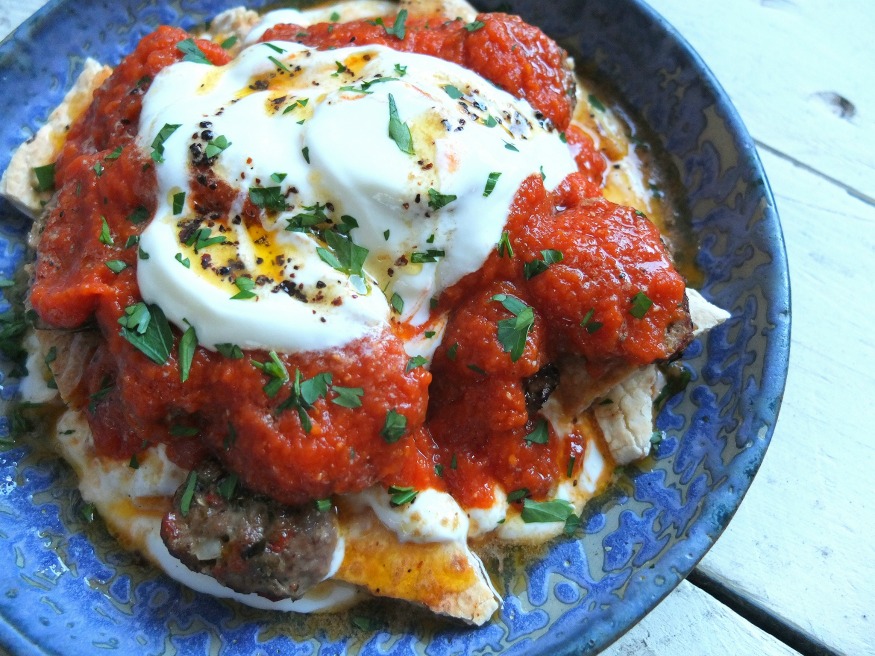
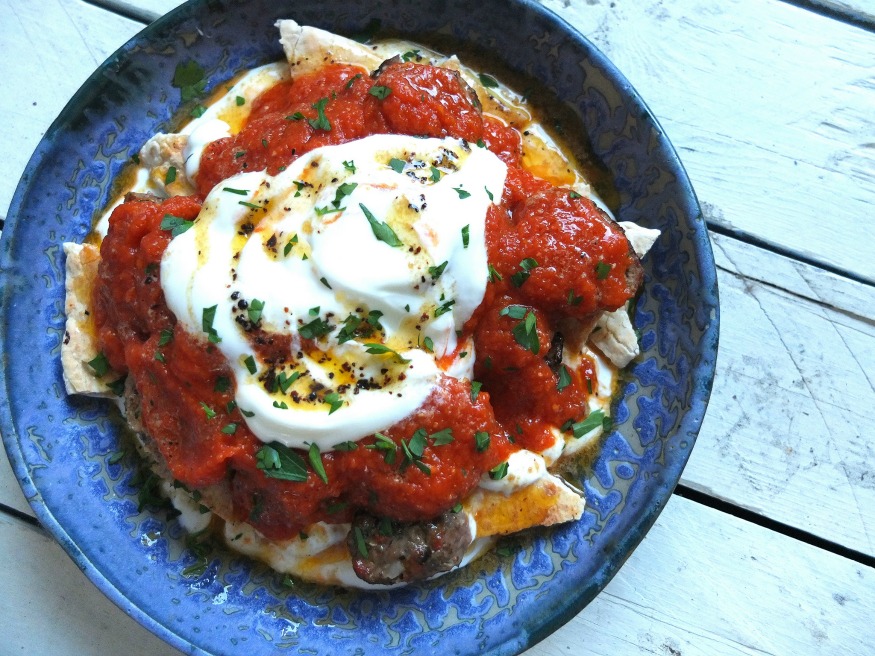
This is a dish that combines everything I love about Turkish food. There’s yoghurt and spiced butter, there’s charred tomato sauce and fluffy bread and there are those fatty little kebabs, hot and fragrant. The yoghurt soaks into the bread at the bottom so it swells up all plump and happy, just like me after I’ve eaten it. It’s one big mess of smoke-licked Turkish fun and for a while, I just couldn’t get enough. I fell hard. I wanted more.

yogurtlu-adana

I knew I could make it at home but really, why would I when it’s right there, just across the road? Well, because. Because I’m a cook and a food writer and I can’t bloody help myself. Also, what if someone didn’t get to experience the joy of Adana yogurtlu, just because they don’t live near an FM Mangal? That would be a sad thing indeed. They would need a recipe. I was doing it for the people *thumps hand to chest in solidarity*.

You could cook this on the BBQ like I did for this recipe but it’s cold out, guys. I whacked them under the grill making sure to get lots of nice crispy bits. The dish needs to taste mangalised (that’s definitely a word, albeit an entirely new one). It’s a great feed, I tell ya, so do consider making it unless you live opposite FM Mangal, in which case, carry on. Will I stop going to FM Mangal now I’ve made this recipe? Will I hell. I’m busy and anyway, they give us Raki.

This post is part of some work I did with Leisure range cookers (it’s the second of two recipes, the first is here). I was their ‘meat representative’. You can find out more about the campaign here.

Adana Yogurtlu Recipe

This recipe will serve 6.

You’ll find the recipe for the Adana here.

For the tomato sauce

1 regular onion, finely chopped
½ green pepper, finely chopped
3 cloves garlic, crushed or finely chopped
2 tins chopped tomatoes
2 teaspoons chilli flakes
Olive oil

Cook the onion and pepper gently in a couple of tablespoons of olive oil until soft but not coloured. Add the garlic and cook for a few mins. Add the tomatoes, salt and pepper. Bring to simmer, put a lid on and let cook very gently for about 1.5 hours. Blend the sauce. Taste for seasoning and adjust if necessary.

For the spiced butter

100g butter
2 heaped teaspoons Urfa chilli

To serve

Pitta, toasted (1 per person makes sense but hey, up to you)
Natural yoghurt (must be full fat, don’t mess about)
Chopped parsley

To assemble

Spread some yoghurt onto a plate. Layer with chopped, toasted pitta, more yoghurt, sliced Adana kebabs, tomato sauce, a final dollop of yoghurt and then a generous drizzle of spiced butter. Scatter with parsley. Serve.

Shawarma Spiced Lamb
This post is part of some work I did with Leisure range cookers. I cooked the shawarma spiced lamb at a Guardian reader event and now I’m posting it here so you guys can make it too. I was their ‘meat representative’. You can find out more about the campaign here. Photo: Uyen Luu for The Guardian. 

We are lost in Beirut. Again. It’s after dark and we trudge dusty back streets stopping occasionally to ask for help. No one knows where anything is, let alone the shawarma bar I’ve had a tip-off about. It is stressful. In the background, cars scream along the main road, honking horns echoing in the underpass. I’m sure we hear a crash in the distance.

We carry on pacing the stony ground, our feet filthy now in flip flops, noses clogged with grime. The heat is sticky and all we can think about is driblets of condensation running down beer bottles, the overwhelming relief of a rattling fan on a clammy brow, and the promise that is a plate of the finest shawarma.

In Lebanon, lamb pieces are stacked on the spit and basted in the animal’s own fat. The sheep in that part of the world have fatty tail cushions, full of precious gold which can be secured to the top of the spit, held in place with a cut lemon. As the spit rotates the fat melts down the sides, adding flavour. The real prizes are to be found at the bottom of course, where scraps of meat and vegetables lay, sucking up the fallout.

The shawarma in Beirut

Eventually, we find the restaurant, which is unexpectedly large. Two spits creak lazily in front of vertically stacked coals but beyond, it’s a vast, strip-lit cavern. A few patrons sit at the plastic tables watching sport on flickering screens and I think that perhaps this place isn’t so different to Camberwell Church Street at 2am, after all.

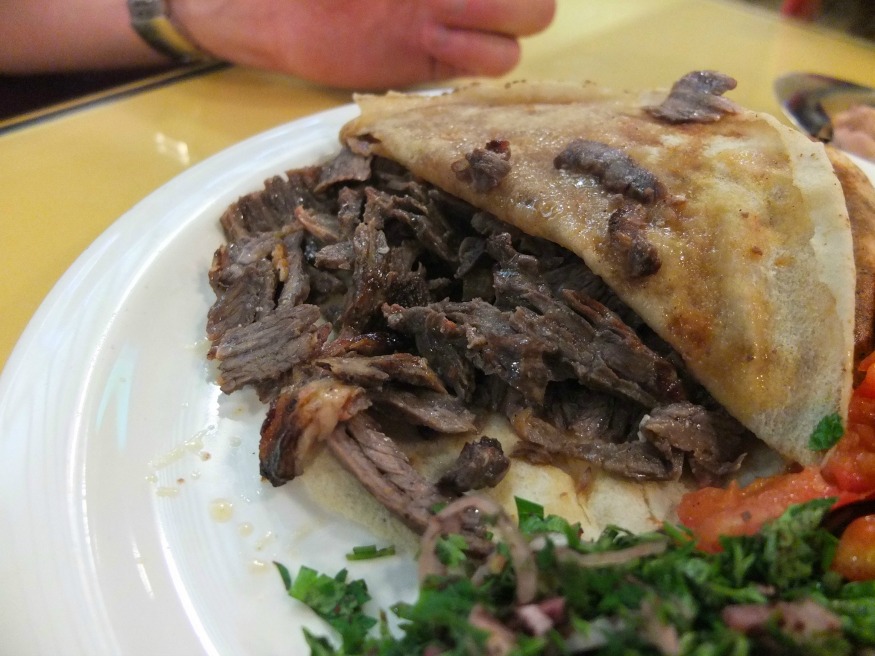
And then we taste. A shaven pile of spice-scented lamb arrives on a no-nonsense metal tray, steaming underneath floppy flatbread. As we lift cautiously and peek underneath, a puff of steam rises, full with cloves, cumin, cinnamon. We alternate with mouthfuls of salad, heavy with parsley and sumac, our fifth or maybe seventh meal of the day – the perils of being a food obsessive in a foreign land.

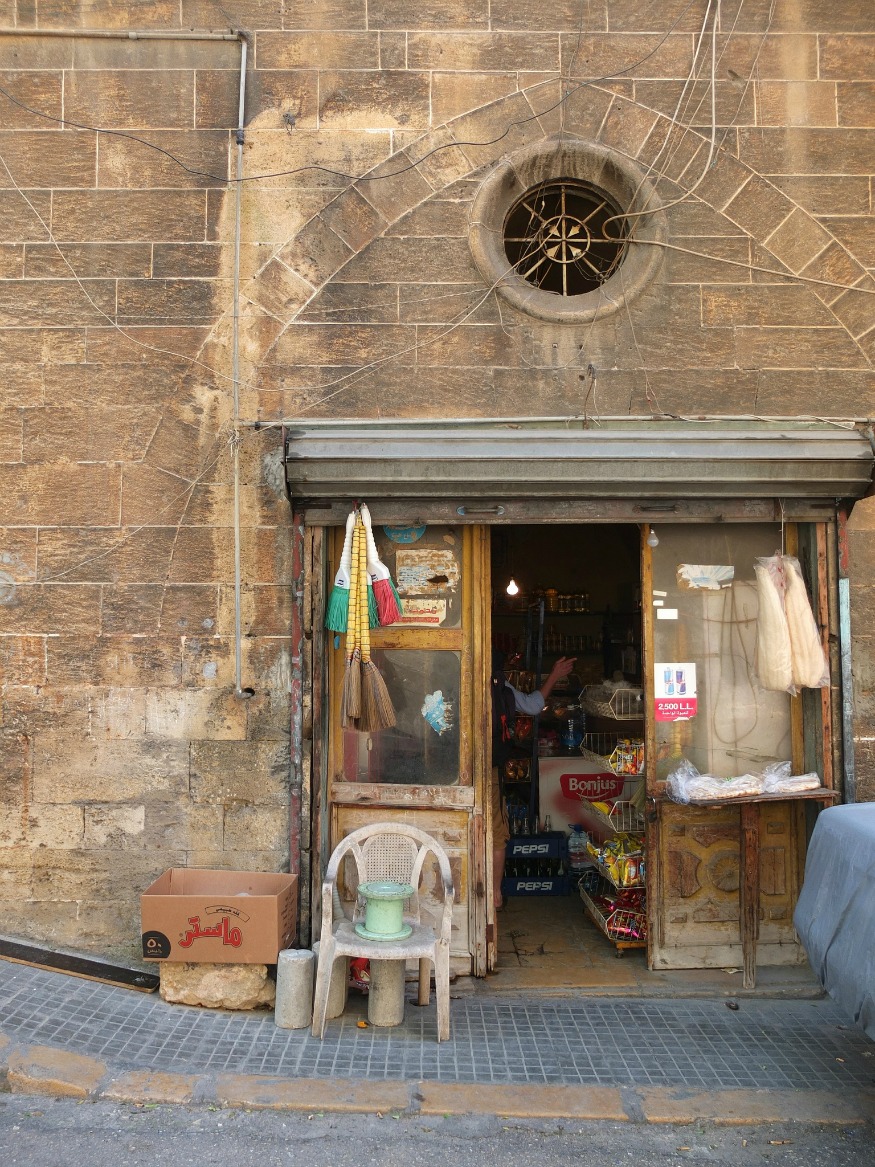
A shop in a Beirut back street

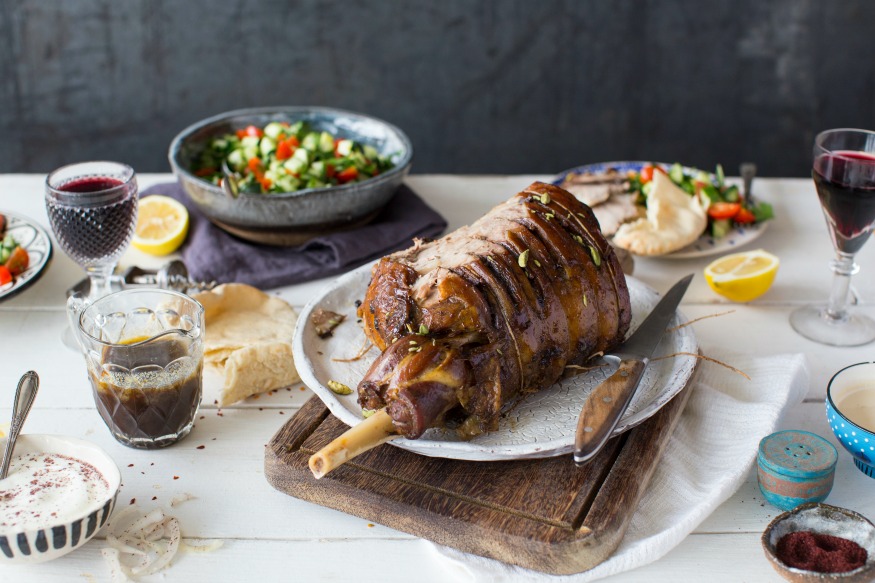
It’s also possible to get a taste of Lebanon at home, of course, which is why I’ve adapted the recipe in a very free and easy way (read: not at all authentic), for the home cook. It’s a bit of mixing, rubbing and then bunging in the oven for a lot of hours. It comes out very tender so you can pull it apart and eat with flatbreads, tahini sauce and an onion salad with sumac.

What I think is great about this recipe is that the spices really penetrate the meat, and regular basting keeps it moist, so you can have a little taste of Lebanon, even in the absence of a spit in your kitchen and fatty tail cushions on your sheep.

Shawarma Spiced Lamb

This will serve six easily. Don’t worry that the recipe looks long, there’s not really much effort involved.

1 x 2.5kg bone-in leg of lamb

For the shawarma spice mix

1.5 tablespoons cumin seeds
2 teaspoons black peppercorns
1 teaspoon coriander seeds
1 teaspoon fennel seeds
½ teaspoon fenugreek seeds
5 cloves
½ cinnamon stick
3 cardamom pods
1 tablespoon paprika
1 tablespoon sea salt (such as Maldon)

For the marinade and cooking the lamb

5 cloves garlic, crushed
Zest of 1 unwaxed lemon, in thick strips (remove any white pith from the underside of the strips)
2 onions, sliced
100ml flavourless oil, such groundnut

Using a dry, heavy-based frying pan, toast the cumin seeds, peppercorns, coriander seeds, fennel seeds, fenugreek seeds, cloves, cinnamon stick and cardamom pods over a low heat. Move them around the pan on a medium heat for a few minutes, until they become very fragrant. Remove from the heat and grind to a powder in a spice grinder, then mix in the paprika and salt.

Combine the spice mix with the oil and garlic. Score the leg of lamb a few times on top to allow the marinade to penetrate, then smear the marinade all over the lamb, making sure to push it right into the slashes you’ve made, covering every nook and cranny.

Leave to marinate for at least four hours, or overnight.

Bring the meat out of the fridge an hour before you want to cook it, then preheat the oven to 200C/Gas Mark 6/180 fan assisted.

Place the lamb in a roasting dish and cook for 1 hour, uncovered, until the lamb has browned.

After this time, reduce the heat to 160C/Gas Mark 3. Add the onions and lemon zest strips and water to a depth of 1cm in the base of the pan. Cover with foil and cook for 4.5 -5 hours, until the lamb is very tender. Baste the lamb with the water in the pan every hour, topping up as necessary to make sure it doesn’t dry out. Don’t skip the basting as it will keep the lamb tender.

Allow the lamb to rest for 15 minutes before carving.

Serve the lamb with the salads and sauce, plus pitta or flatbreads, pickled chillies and/or pickled turnips and yoghurt.

For the Israeli salad

3 small Israeli cucumbers or 1 large English cucumber (seeds removed if the latter), diced
3 tomatoes, diced, or 15 cherry tomatoes, diced
1 handful parsley leaves, finely chopped
1 small handful mint leaves, finely chopped
2 tablespoons lemon juice
1 tablespoon olive oil

Mix all the ingredients together and season with salt and pepper. If made more than 15 minutes in advance the salad will accumulate juice at the bottom of the bowl – it is up to you whether you drain this off.

For the onion salad

2 regular onions, thinly sliced
1 heaped teaspoon sumac
1 teaspoon salt

In a bowl, mix the onions and salt, rubbing the salt into the slices with your hands. Add the sumac. Allow to sit for 5 minutes before serving.

For the tahini sauce

100ml tahini
50ml lemon juice
100ml water
1 small clove garlic, crushed
Salt (a pinch)

Put all the ingredients except the salt in a food processor and process until smooth Taste and add salt if needed.

harissa

I am currently finishing my PhD – a hangover from my life before food. People that know me in real life are sick of hearing about this, and will have stopped reading after that first sentence (if they bother reading this site at all). It is a horrendous experience, the PhD, even as a writer. The sheer scale of the workload is terrifying, overwhelming, and it makes me break down into a wobbly fit every time I think about how much I haven’t done yet.

It’s very weird, too, swapping constantly between academic and creative writing. The former is all about clearly stating facts and results, but my PhD is also quite theoretical, so it’s mind bending and headache-inducing too. Then I have to stop doing it for a while and write something about a lunch I had in Azerbaijan at the home of a little Russian lady, recreating the atmosphere, describing the scene, conjuring memories of the food. My brain is doing some serious acrobatics and you know what? I’m KNACKERED. Thank heavens for this blog where I can just let the words spew out of me (sorry).

Still, it’s my fault, because I chose to do the PhD in the first place. The point of me telling you this is that I am cutting out all non-essential activities, like having fun in the kitchen. Usually, I might spend an hour or so making something nice for lunch – now I scuffle back and forth to the fridge in my pyjamas, grab whatever is inside and eat it. I barely have time to slap together a sandwich. Gasp! As if I ever just ‘slap together’ a sandwich… I can’t believe you would think that.

chillies
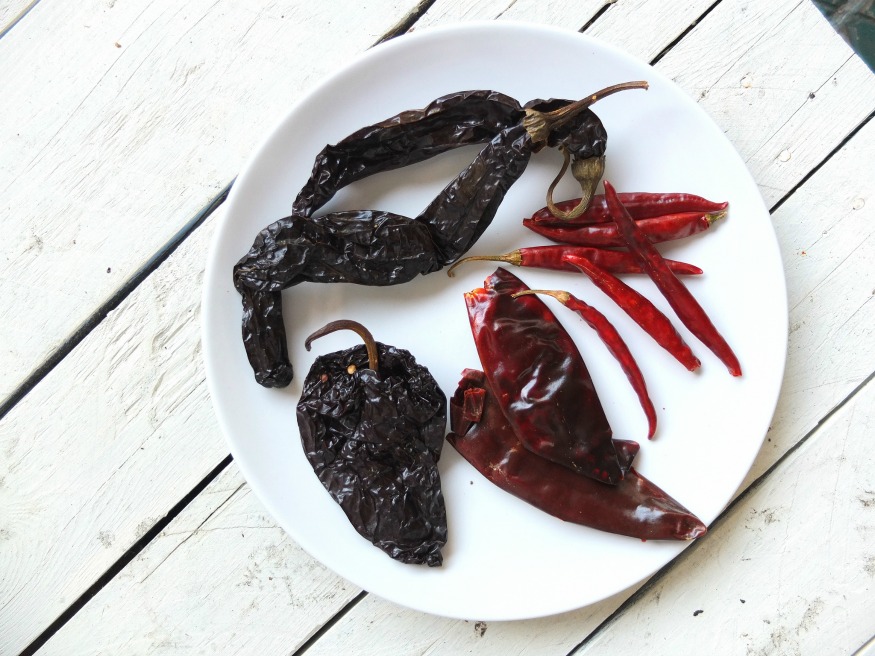
Clockwise from top: Guajillo, Chilli de Arbol, Pasilla, Mulato.

The problem is, the no cooking thing is not sustainable. Not for me, anyway. Food is my life. I will become depressed. So, I am stockpiling brilliant things that I can stick in the fridge and sort of blob on top of bowls of rice with chicken and veg or whatever. Hello, then, to harissa.

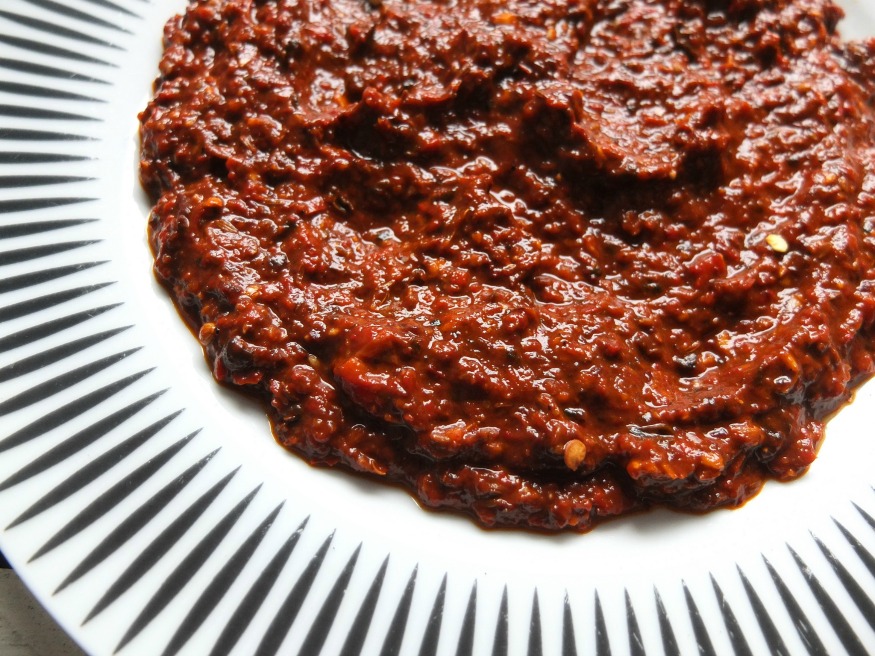
It’s a mongrel recipe because we basically just dug around in the cupboard – the bit right at the back where you can feel the spiders’ webs – until we found the rustling packets of dried chillies. Hands came back clutching smoke-laced Ancho, spiky Chilli de Arbol, fruity Guajillo and the curious, squat Mulato. We also roasted some good old regular fresh chillies and a pepper and mixed the lot with cumin seeds, coriander seeds, caraway and garlic… it’s punchy.

You could use any mixture of chillies you like I suppose, as long as what you have at the end is something so full of flavour you can just stir small amounts into other dishes, spread it on a sandwich, mix with yoghurt or mayo, use it to coat chicken wings… whatever. Would it be easier to go and buy a jar of harissa? Sure, but where’s the therapy in that? This way, I enjoyed the scent of smoky chillies curling around the kitchen; I roasted peppers until sweet and blackened, then slipped off their skins; I dry-toasted spices, sucking up the citrusy scent of coriander seeds, then I whizzed it all together and I felt better. I felt better before any of it had even passed my lips.

Harissa Recipe

This fills a 350g jar.

1 dried Ancho chilli
1 dried Mulato chilli
3 Chilli de Arbol
2 dried Guajillo chillies
1 dried Pasilla chilli
1 red pepper
5 regular mild fresh chillies (not cayenne but the ones you get in supermarkets. What are these called, please?)
1 teaspoon cumin seeds
1 teaspoon coriander seeds
1/2 teaspoon caraway seeds
5 cloves garlic, peeled
Juice of 1 lemon
1 tablespoon olive oil, 1 tablespoon rapeseed oil (yeah this was a bit random, so you could just use 2 tablespoons of flavourless oil, like groundnut)
2 teaspoons good sea salt

Soak the chillies in boiling water for at least half an hour. It’s easiest if you weigh them down with something like a plate or bowl, to stop them bobbing to the surface. Once soaked, remove the stalks and seeds.

Char the peppers and fresh chillies over an open flame until blackened all over. I did this on my hob (watch them and turn frequently) but you could do it under the grill. If you roast them in the oven, the flavour of the red pepper would be stronger and might overwhelm everything else. Once they’re blackened, wrap them in cling film for five minutes (this makes the skin easy to peel) then, peel and discard the stalks and seeds. It’s easiest if you run them under the tap while you’re doing it.

Add the chillies to a blender with all the other ingredients and whizz to a paste. Keep in a sterilised jar in the fridge.

Jerk Octopus

It’s fair to say I’ve had a few disasters when it comes cooking octopus. People still say to me, in actual real life rather than just on the Internet, “OH MY GOD THE RED BAG THOUGH,” referring to the time I cooked one in a bag and it came out looking like someone’s blood donation. A friend said this less than a week ago, and the Octopus Red Bag Incident was in February 2013 – we are all still traumatised.

I was experimenting with sous vide at the time (yeah I know, but we all did it) and the octopus released its juices into the sous vide bag and I wasn’t aware that those juices are naturally quite red. Pulling that thing out was quite the shock and I was then too scared to eat it.

Suck up that flavour.

There have been other issues – mainly to do with getting the octopus tender, and you’ll come across various bits of advice. People will tell you to put a cork in the water when you’re cooking the octopus but don’t bother. I read somewhere that this myth probably comes from a time when they were cooked in huge tubs with corks and string tied to them – the cork would float and make the octopus easier to pull from the water.

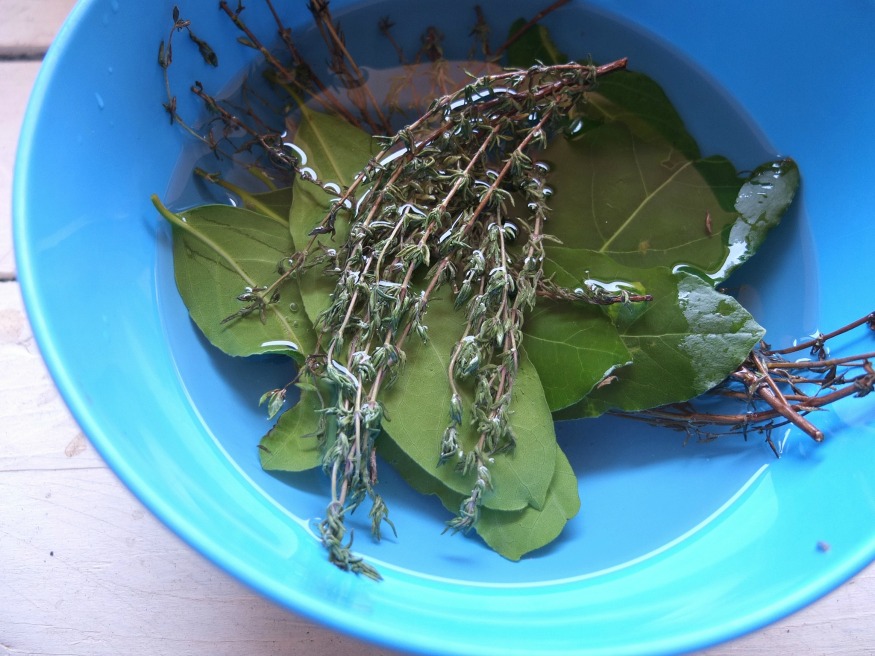
Bay leaves and thyme soaking.

I buy a frozen octopus because it does seem to make a difference to the texture and they’re more readily available (though not cheap). I then cook it in a pan with a little water and its own juices – they release so much that it’s enough to simmer them without adding much else although of course, you can add red wine or whatever you like. Once its tender around the skirt (the bit where the tentacles join the head), you’re good to go.

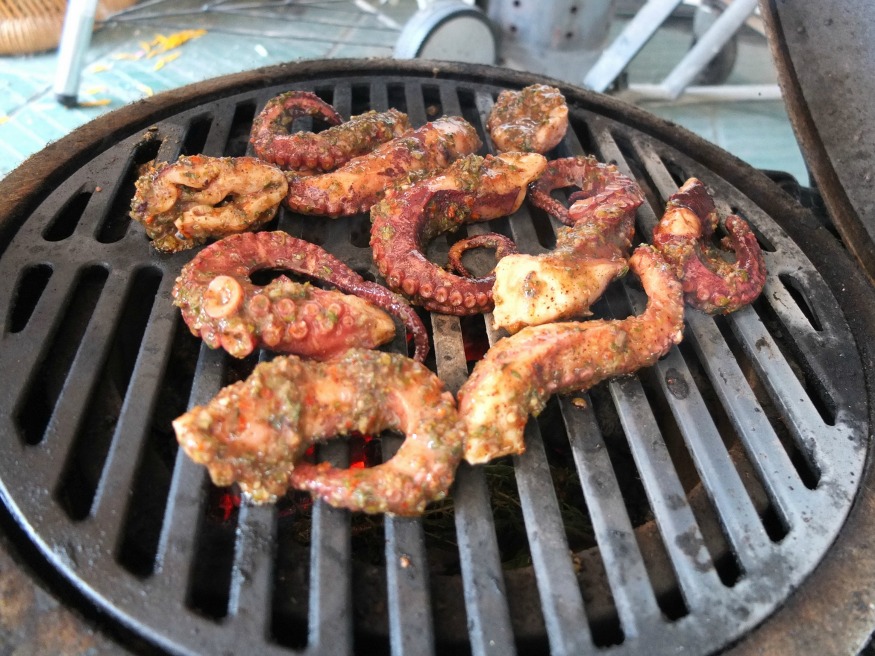
Sizzlin'

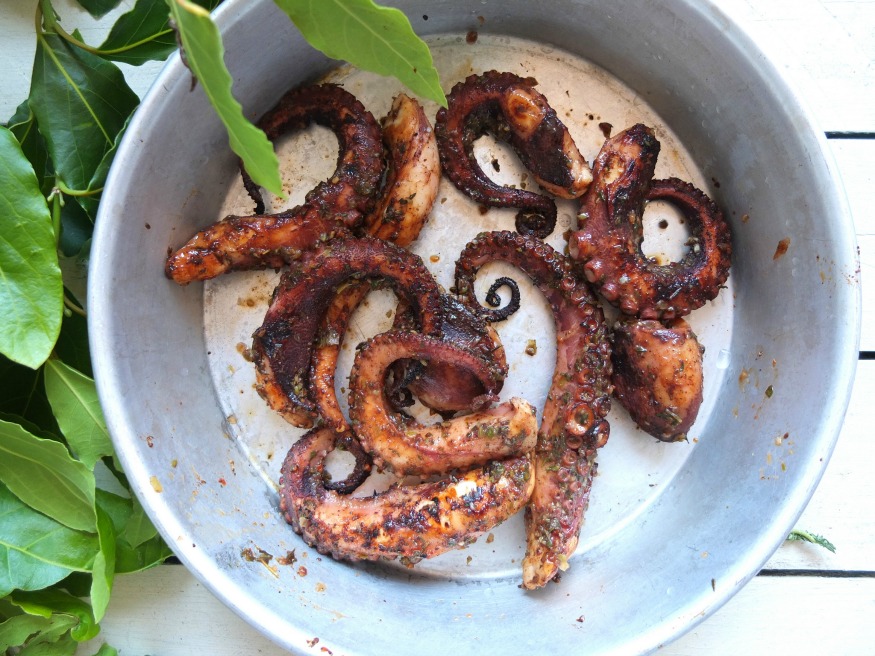
So I wondered why no one ever seems to jerk octopus because – and I’m not even joking here – it tastes quite a lot like chicken. You can jerk seafood too of course and it just all made sense. Was there something I was missing? Well, no, is the answer. The only thing I was missing was jerk octopus in my life. Yeah, it’s a bit of effort but this magnificent creature is prime for a bit of jerkin’ – marinate as usual once it’s cooked, then crisp up those tentacles on the BBQ so they’re charred outside, tender on the inside… fabulous.

Jerk Octopus

We ate it with the most unashamedly 90’s rice salad and I’ve now decided I need to write about that separately. It has huge nostalgic significance for me. Here, then, is a recipe for jerked octopus. There are no sous vide bags, no corks, no shocks and hopefully no mental scarring.

Jerk Octopus Recipe

1.5kg octopus (doesn’t matter really though, the cooking method is so simple)
1.5 tablespoons allspice (freshly ground if you can – buy the berries and grind them)
50g dark packed brown sugar
4 garlic cloves
1 tablespoon thyme leaves
1 bunch large spring onions (about 5)
1/2 teaspoon cinnamon
1/4 teaspoon nutmeg
1/2 teaspoon ground ginger
1/2 teaspoon ground cloves
3 scotch bonnet chillies, deseeded
Juice of 2 large limes
1 teaspoon salt

Thaw the octopus and put it in a (lidded) saucepan large enough to fit it comfortably. Add some water until it comes halfway up the octopus. Bring it to the boil, turn down to a gentle simmer, put the lid on and cook very gently for 45 minutes to and hour, or until tender when you poke a knife in into the top of a tentacle (where they join the head).

Allow the octopus to cool, then remove the tentacles.

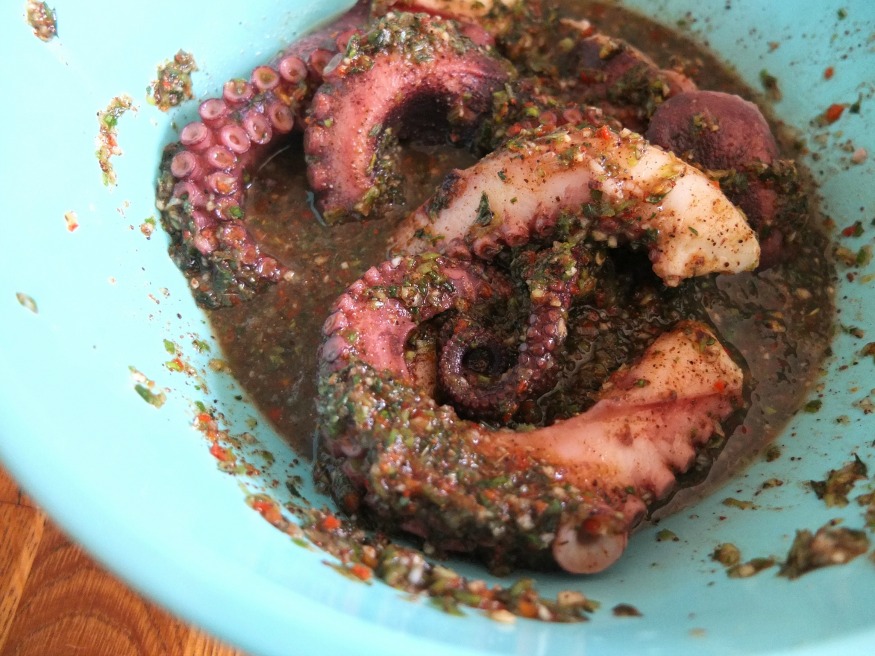
Blend all the marinade ingredients and combine with the octopus. Leave for a couple of hours in the fridge if you can.

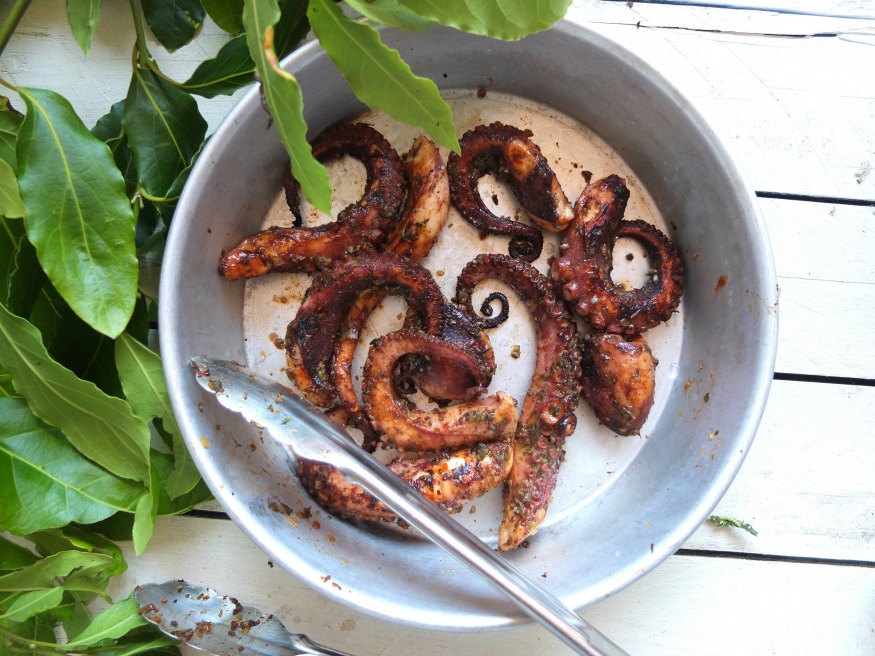
Cook the octopus on a BBQ over direct heat – it won’t take long. With chicken I make a bed of bay leaves soaked in water to cook the chicken on but the octopus isn’t on there long so this time, I chucked them in the coals with some soaked thyme which makes lots of lovely, scented smoke. Cook the octopus, flipping frequently until a little charred, brushing every now and then with the marinade (remember: the octopus was cooked before it went in the marinade so there’s no need to worry about contamination).

Serve hot with your choice of sides.

BBQ Chicken Caesar Salad

Regular readers will know that I had to get a personal trainer because being a food writer made me fat (there is absolutely nothing wrong with being fat – I just wasn’t happy). When I first started he – my personal trainer – asked me to keep a food diary, to which I responded, “boy, are you in for a shock.”

At the time I was judging an afternoon tea competition, which required me to eat six teas a week for a couple of months. I’ve never seen anyone’s mouth drop open so fast (except perhaps mine every time I walk into the kitchen and see the peanut butter banana bread I’ll be posting about next week).

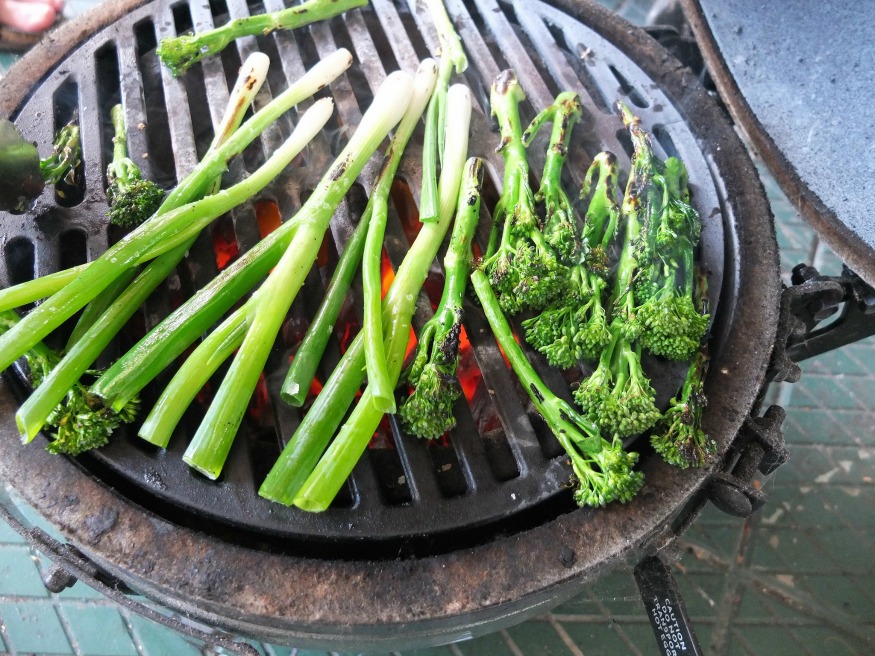
Grill the spring onions and broccoli too.

Every now and again he still says something like, “so, how’s the food going?” to which I respond, “um, yeah fine” because I really don’t know what else to say. How do I tell him that I started the day with a cheese börek from the Turkish food centre, spent the day testing recipes, which meant I ate two lunches and then I’m out for dinner because I’m working on an area guide?

Yeah I know, you’re jealous. Well, let me tell you that actually, eating a lot is hard. Often I just want to sit in bed and slurp instant noodles while watching Netflix.

And sometimes, I just want to eat a salad.

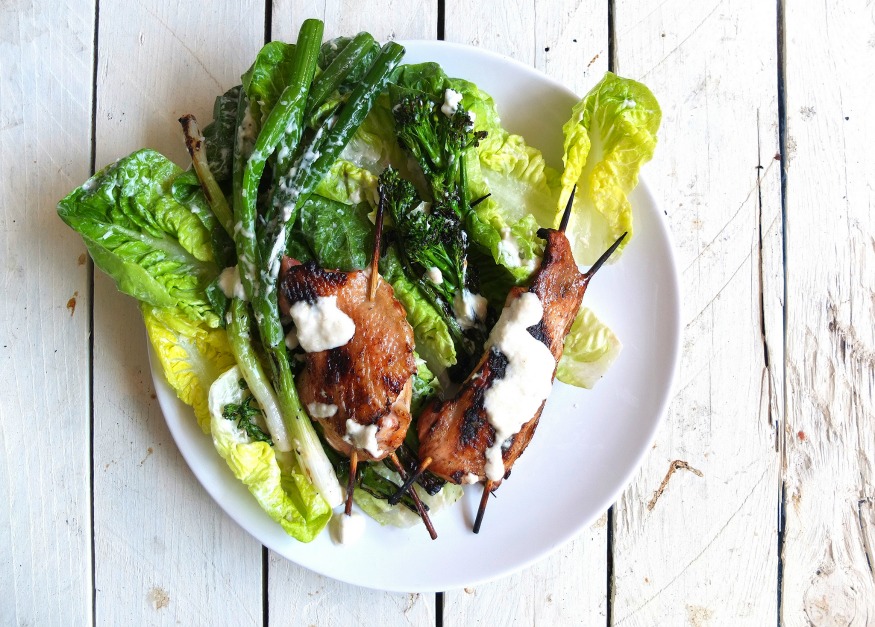
I made this salad on Snapchat last week and loads of people asked for the recipe. It barely resembles a traditional Caesar but really, who cares? The chicken is cooked on the BBQ because that’s fun and tastes great, but we’ve also had it just grilled or bashed thin then fried in a skillet. We add Tenderstem broccoli because I’m obsessed with it and also because this salad is a celebration of green things. I love the flavours of Caesar but really it’s just a load of lettuce in a bowl. This, my friends, is more satisfying.

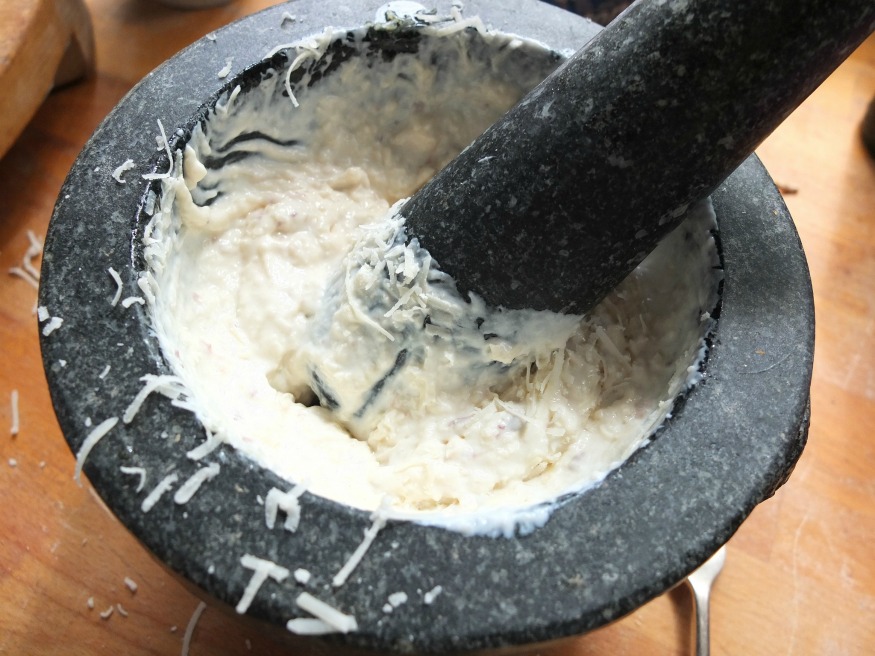
Making the dressing.

Finally, no mayo here because I just find it gross in dressings, coating the back of your throat like engine oil. Grim. Yoghurt is fresher and combined with garlic, Parmesan and anchovies makes a really lovely, rich yet sharp dressing.

Oh, one more thing – there’s a lot of garlic here, so I wouldn’t advise eating this before, say, a meeting, or indeed any human contact. Big flavours are what makes healthy-ish food work for me – it’s basically the opposite of energy balls, obscure flours and the milking of things that have no teats (see: almonds). I’m all about balancing salads with banana bread, and I’m about hitting a gym where the trainer kicks my ass so hard I sweat from my eyelids.

Super Green BBQ Chicken Caesar Salad

This serves two for a massive lunch that’ll make you feel like a total boss in the nutrition department.

For the dressing

4 cloves garlic, crushed
1 scant teaspoon sea salt
5 anchovy fillets
100g grated Parmesan
2 tablespoons olive oil
Juice ½ lemon (but reserve the other half)
3-5 tablespoons natural yoghurt

For the chicken

4 chicken thighs, boneless (I leave the skin on because again, I’m not wasting chicken skin for the sake of saving calories)
Salt and pepper

For the salad

6 spring onions
200g Tenderstem broccoli
2 little gem lettuces, leaves separated

Prepare a BBQ for direct cooking.

Open out the chicken thighs and give them a little bash if needed to make them the same thickness all over. We used skewers to fan them out too as you can see from the photos. When it’s ready, rub the spring onions and broccoli with a little oil and salt and pepper, and grill under tender and slightly charred (5-10 minutes).

Set aside while you cook the chicken. Season and cook over direct heat, turning every so often, until cooked through – around 20 minutes depending on the size of the thighs.

In a pestle and mortar, bash up the garlic with a pinch of salt. Add in the anchovy fillets and mush them up too. Add about half the cheese, mush it up then add the yoghurt. Stir in the rest of the cheese, plus the oil and lemon juice. Check for seasoning and balance – add more lemon juice or some black pepper if you want it.

Mix the lettuce leaves and a heaped tablespoon of the dressing in a large bowl then mix with hands. Do the same thing with the Tenderstem and spring onions.

Arrange on a plate and top with the chicken and a bit more of the dressing to taste.

Adana Kebabs

A few weeks back I was all geared up to tell you how I’ve been writing this blog for ten years. Ten years! I would tell the story of how it all started, reminiscing about the first post I wrote and what I’d cooked. There was even a special ‘anniversary’ recipe – further evidence that I’m a sentimental douche.

Then I realised that actually, I’ve only been going for nine years. Pathetic. I got it wrong and so you’ll have to wait to hear how I got into trouble with the council because I started a food blog. And no you can’t look up the post, clever clogs, because when I changed the design of this site the first time around, a load of stuff got lost, including that. I’m not even lying because I’m embarrassed and I don’t want you to read it, (if you want to find some terrible cringe-y old content on here then there’s plenty more to choose from).

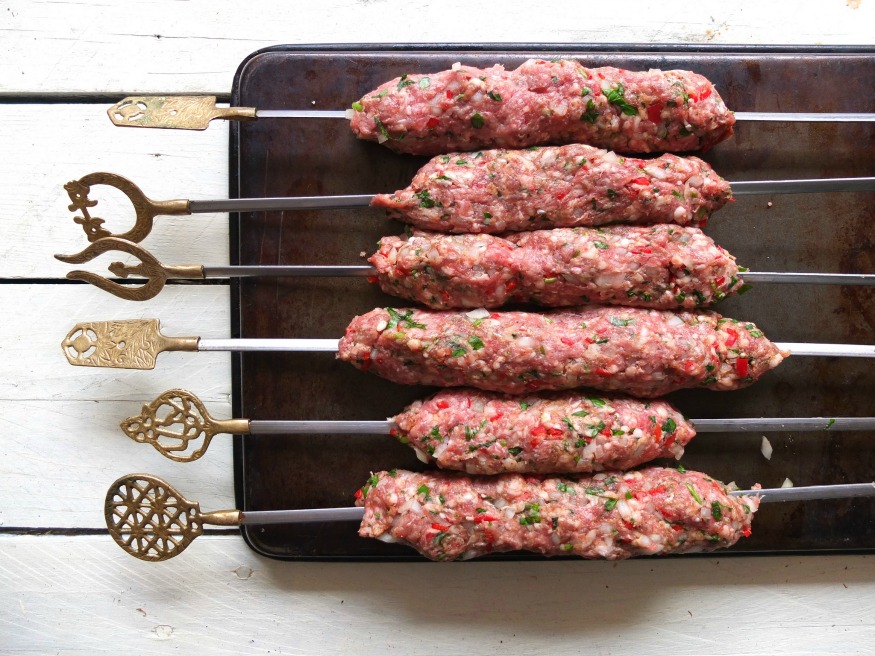
You could make yours the same size.

So the new, celebratory recipe I’d been working on was a kebab, which possibly reveals that my first ever recipe on here was, too, of that nature. I feel like I started out strong and then maintained a stream of posts dominated by grilled meat, swearing, butter, hot sauce, BBQ and general mischief.

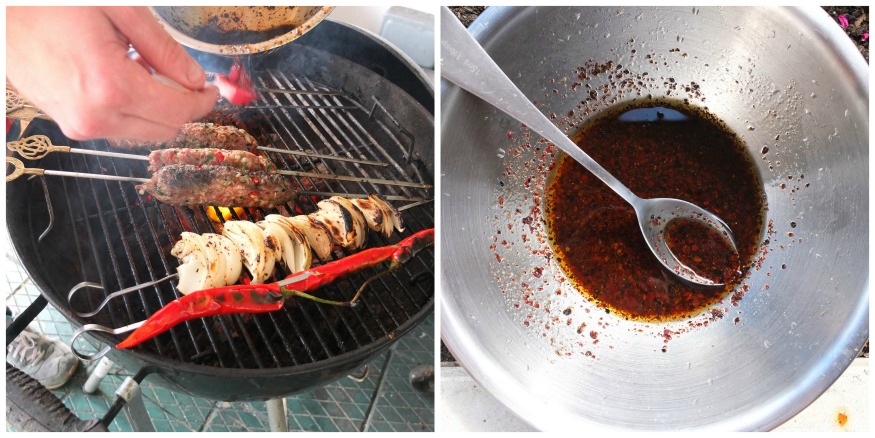
Brushing the Adana

Anyway, we’re not getting into all that until next year. What I’m doing now is giving you a bonus Adana kebab recipe because YOU’RE WORTH IT. This is Donald’s recipe for kebabs, which is annoying because it’s better than the one I made and then published in my book. Don’t you just hate it when that happens? The recipe in my book is still great, FYI, it’s just that you know, recipes evolve and all that. This Adana is so much more an Adana for ‘right now’. It understands me in a way that no other Adana does. It’s not the old Adana’s fault, it’s mine etc. etc.

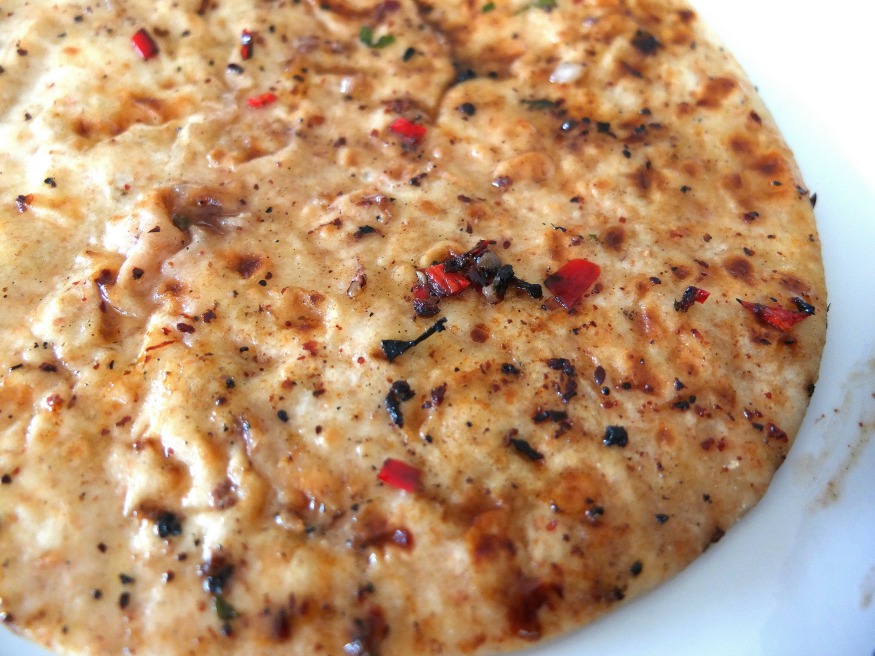
You want all the kebab juices to soak into your bread.

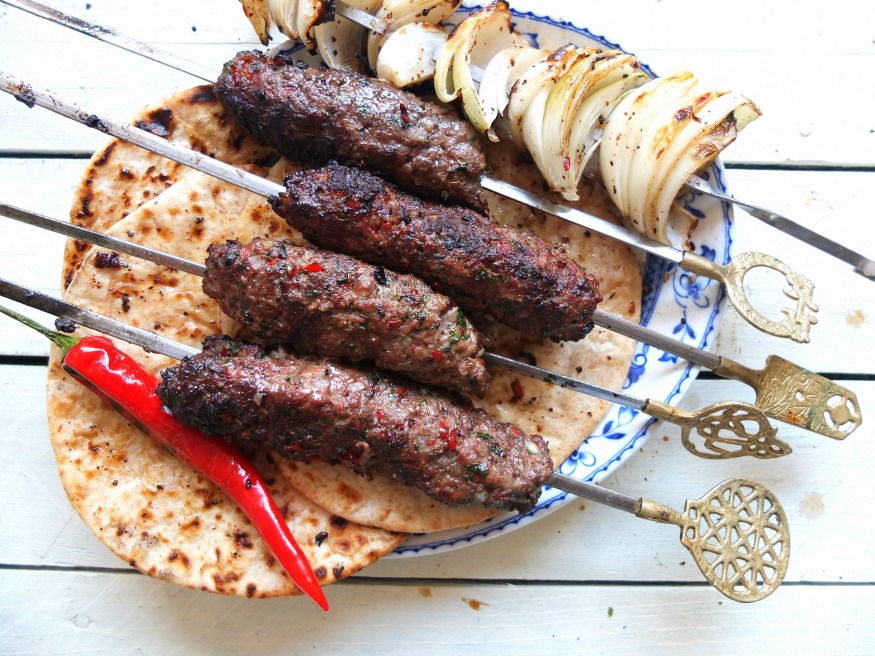
The reason they’re so good is partly down to the spice mix, partly down to the cooking method. They’re not even really proper Adana, that’s just what we call them because they’re spicy and made with lamb.

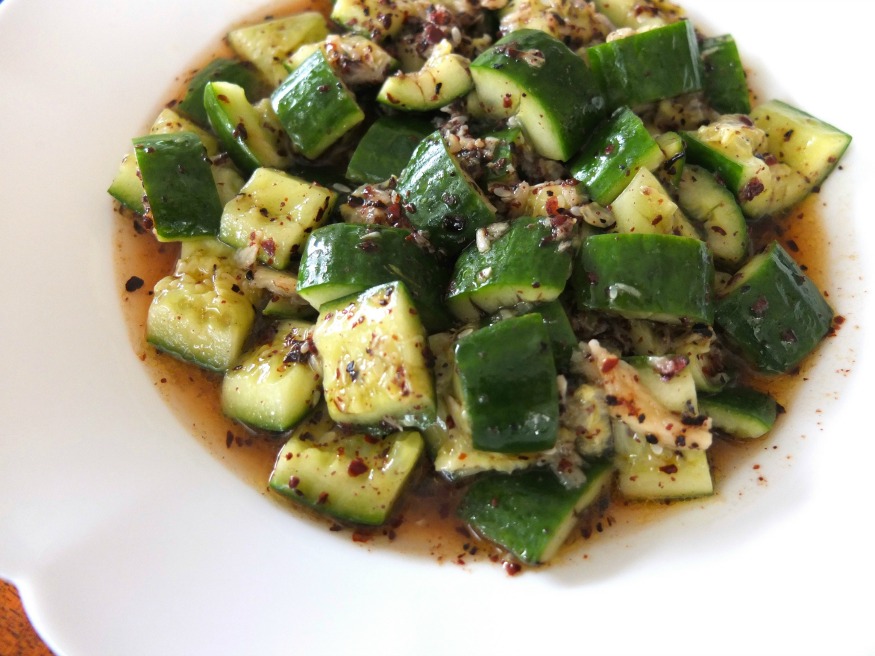
The smacked cucumbers

The other great thing here is the side salad, which takes the method of Sichuan smacked cucumbers but uses flavours more appropriate for Turkish kebabs. So it’s got loads of garlic as usual but also sumac and Turkish chilli and it might even be my new favourite summer salad. So there.

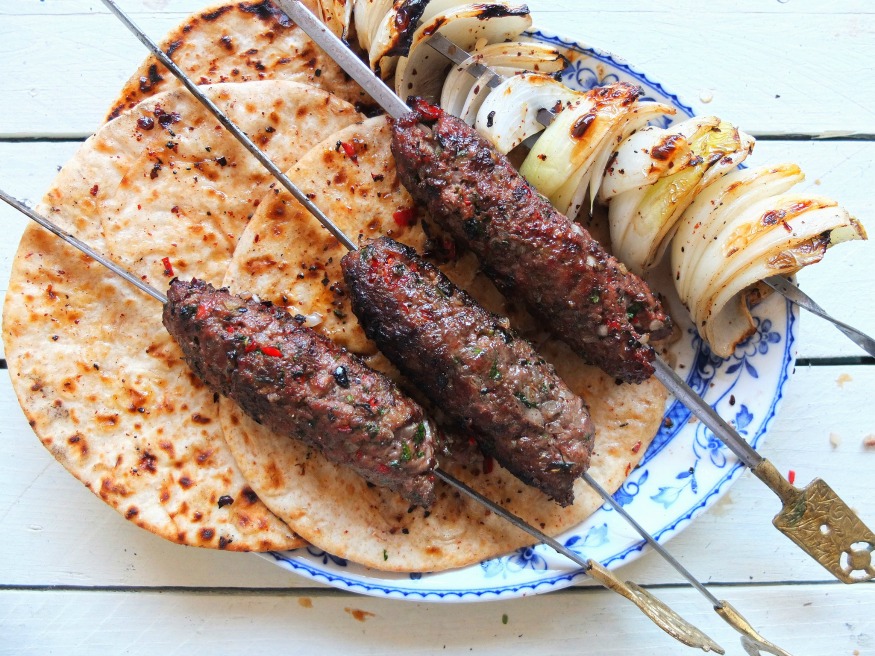
I recommend grilling some onions and chilies to serve on the side.

You’ll cook these kebabs on the BBQ, obviously, and eat them with flatbreads and yoghurt while you practice counting to ten. It’s surprisingly easy to get rusty.

Donald’s Not-Adana Kebabs Recipe

*** THIS IS NOTHING LIKE A TRADITIONAL ADANA KEBAB, RECIPE IT WAS JUST INSPIRED BY ONE***

For the spice mix

2-inch cinnamon stick
1 tablespoon cumin seeds
1 tablespoon coriander seeds
1/2 tablespoon caraway seeds
4 dried red chillies
6 cardamom pods
20 black peppercorns
1 tablespoon sea salt

Bash the cinnamon stick a bit then grind the whole lot in a spice grinder.

For the basting sauce

2 tablespoons pomegranate molasses
2 tablespoons cider vinegar
1 tablespoon olive oil
2 teaspoons sumac
2 teaspoons Urfa (Turkish) chilli flakes
2 teaspoons sea salt
A grind of black pepper

Mix it all together.

For the kebabs

750g minced lamb
2 red chillies, de-seeded
1/2 onion, finely chopped
Generous handful parsley leaves, chopped
1.5 tablespoons spice mix (above)

Mix everything together and knead it really well with your hands – about 5 minutes. This is important for the texture of the kebabs so don’t skip it. Divide into six portions (or whatever your skewers will allow) and shape into logs. Thread skewers into the logs. It’s best to use flat, wide skewers here or you risk the kebabs falling off. If yours are quite round, use two per kebab.

Leave to rest in the fridge for an hour or so. Prepare a BBQ with the coals to one side – it’s best to cook them to one side because otherwise the fat will drip and make the BBQ flare up, burning your kebabs.

Cook the kebabs on the cooler side of the BBQ, basting frequently with the sauce and turning until cooked through – around 10-15 minutes. Towards the end of cooking time, lay the flatbreads on top of the kebabs to get some smoke flavour into them and heat them through. Serve the kebabs on top of the breads so the juices run into them.

To serve

Flatbreads
Yoghurt
Cucumber salad (below)
A skewer each of onion slices and chillies (brush with oil and grill on the BBQ while the kebabs are cooking)

Turkish Smacked Cucumbers

2 of those small cucumbers you get in Middle Eastern grocers or one large English cucumber
3 cloves garlic, crushed
1 teaspoon Urfa chilli
1 tablespoon olive oil
1 tablespoon vinegar (we used ‘grape vinegar’ from the Turkish supermarket but use red wine vinegar (same thing?!), cider vinegar, whatever)
1 tablespoon olive oil
1 teaspoon sea salt

Halve the cucumbers then place them seed side down on a chopping board. Smack them with the side of a cleaver or something else until they’re smashed a bit. Chop into 2cm lengths and mix with all the other ingredients.