My boyfriend is the master of procrastination. To say he gets ‘easily distracted’ is like saying Keith Floyd was partial to the odd glass of wine on special occasions. Sometimes though his habit of poking about in the dark corners of the internet leads to the discovery of gems like this video of ‘disco fry eggs’. How he got there I do not know. I do not need to know.

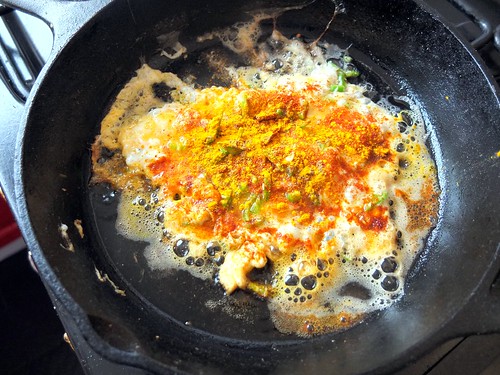
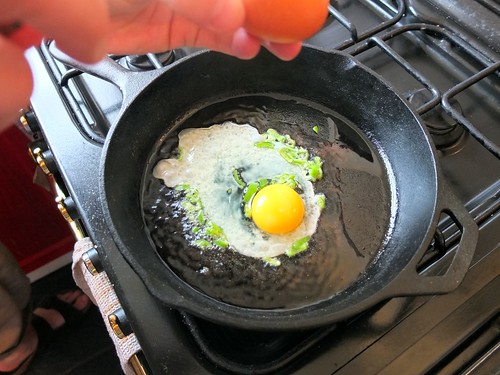
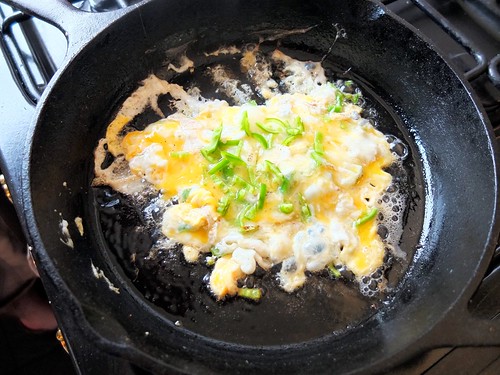
The recipe is amazing. Oil is heated in a fiercely hot pan like a shallow wok, then green chillies are added and the aromatic bite of capsaicin rises. An egg is cracked onto the sizzling oil and smooshed around, before spices rain down from a hand out of shot. We had to identify them by eye – the pollen yellow hue of turmeric made it easy to spot, while the red and brown ones seemed most likely to be chilli powder and garam masala.

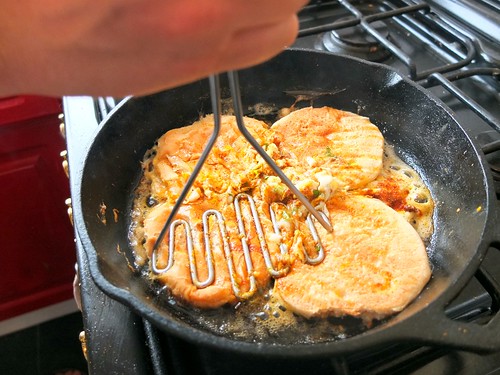
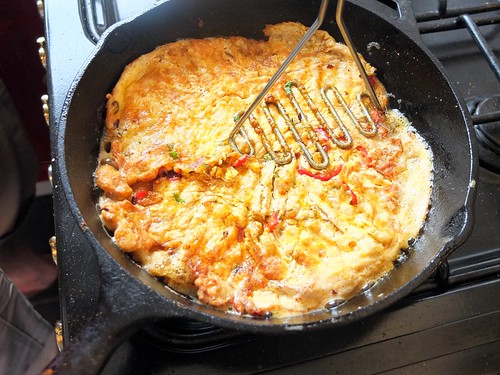
Then comes the best bit, as a bread roll is split and placed cut side down on top of the eggs, before the whole thing is squished down flat with a circular metal thing on a stick. I’ve no idea what this implement is, or once was, but it seems to serve its purpose here very well. We used the obvious substitute – a potato masher.
The whole eggy, bready mix is then flipped and squished, flipped and squished again. There is basically a huge amount of flipping and squishing. Once cooked, and very importantly, really properly squished, the pancake shaped mixture has developed lovely crisp bits around the edge, while there’s still soft, fluffy eggy bits inside. The spices have cooked out but are still boom! definitely there in refreshingly large quantities. At the end the whole thing is split in half and folded to serve.
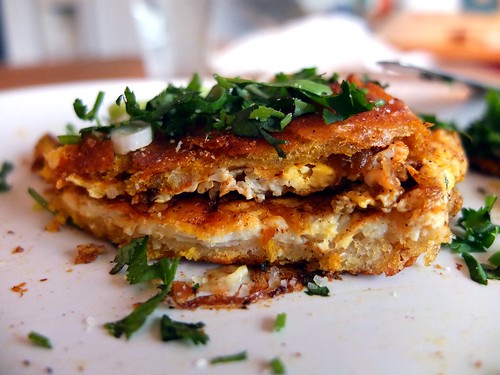
We basically tried to follow the recipe as accurately as we could from the video, trying to move quickly and therefore making a right mess in the process. There is a pair of trousers which I fear will never recover from ‘turmeric-gate’.  The flipping provided some comedy moments. The end result was pretty special though. The only changes we made were to garnish it with coriander because that just made sense and some finely chopped spring onions because they go on everything in this house.

I shall not hesitate to claim that this is clearly the best hangover breakfast of all time that no-one seems to know about. It has eggy foundations, it contains chilli and spices, it’s a bit filthy, and there are laughs to be had whilst making it. The hangover boxes are ticked. The absolute best thing about this though is that I think the bread and the folding clearly qualifies the dish as a sandwich. An Indian eggy bread sandwich. Joy!

Mumbai Disco Fry Eggs Recipe

(serves 1)

One thing you don’t need to worry about is the mixture in the pan looking a mess. It will taste brilliant, I promise. Anyway, the messy edge bits give you the crispy bits of joy that you desire.

2 eggs
2 small soft round rolls, 1 large soft round roll, or 1 hot dog bun, split
3 green chillies, sliced (or more or less to taste)
Chilli powder
Turmeric
Garam masala
Salt
Fresh coriander
Finely sliced spring onions
Oil, for frying

Heat a frying pan or skillet over a medium high heat and add some oil (couple of tablespoons should do it). When hot, add half the chillies and fry briefly. Add the eggs and break them up a bit. Add the rest of the chillies, then sprinkle on a generous pinch each of chilli powder, garam masala, turmeric and salt.

Put the split bun on top, drizzle over a little more oil, and add another dusting of all the spices. Use a potato masher or similar shaped implement to press down on the buns so they are smooshed into the egg. When it’s fairly flat, flip it over and squash down again. Flip again and squash, then flip again and squash. The final result should be flat as a pancake and crisping at the edges.

Cut the eggy pancake in half down the centre. Fold each half into a sandwich, put on a plate, sprinkle with coriander and spring onion, and serve.

In his excellent book, ‘The Yoghurt Cookbook‘, Arto der Haroutunian talks about the health promoting properties of the white stuff, and its supposedly life lengthening power. By my reckoning I should live until at least 180, providing the yoghurt can counteract a history of fags, booze and fast livin’.

Cultures that consume a lot of yoghurt, such as the Georgians, are huge believers in its supposed powers, and have used it as a cure for…well, pretty much everything actually, for centuries. I can’t vouch for the validity of those claims, but I can vouch for the taste, and its hangover-curing properties. This buffalo yoghurt made in a traditional clay pot brought me back from the brink; I’m talking nausea, shakes, the creeping doom…not a whisker of it after I’d gobbled this lot down at the side of a rocky road in Georgia.

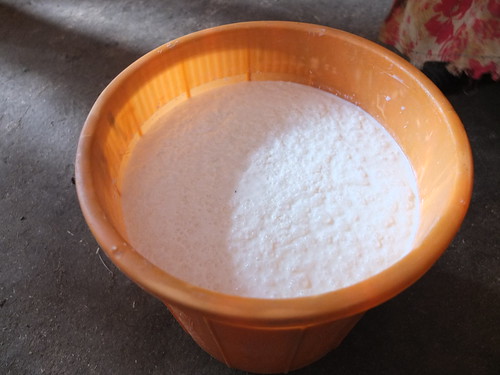
The yoghurt I tried in Ethiopia recently was a little more…challenging. I asked the lady we were visiting how she made it, and she replied ‘well I just put the milk in this bucket (straight from the cow in the back yard) and leave it on the shelf for three days.’ That’s one approach, although it is of course really just curdled milk and not ‘proper’ yoghurt. The taste was very sour and it had a loose wobbly texture. The Ethiopians often mix it with chilli powder and drink the whole glass like a shot, and I can see why. I spent the next three hours concerned about potential gastrointestinal payback.

Yoghurt in Ethiopia

Mixed with chilli powder

Labneh, then, is basically yoghurt that’s been strained of its whey. Of course, I adore it because, well it’s like yoghurt to the power of ten. Once strained, the resulting substance is more akin to cream cheese, but with the obvious tartness of yoghurt; that sour freshness that yoghurt-lovers crave.

I’ve found that the best brand by far for making yoghurt is Total. It’s even better than the mega-expensive stuff I bought from the farmers’ market, which relinquished hardly any liquid. It is thick and creamy before straining  which is a good thing if you’re eating it straight up, but with labneh you want some residual sourness.

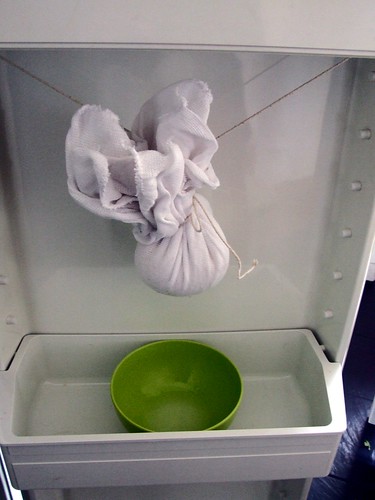
To make labneh, mix the yoghurt with a large pinch of salt, then wrap in muslin, or as I have done, a clean/brand new dishcloth. Hang in the fridge (to be honest I used to just hang it in a cool place but now I have a very hot kitchen so the fridge it is) and allow the whey to strain away for about 5 to 6 hours. The longer the strain, the thicker the labneh, obviously.

After this time it is ready, and can be used or preserved in a number of ways.

Try rolling in herbs and preserving in olive oil…it’s then lovely just spread on bread. It’s also delicious rolled in dukkah, or za’atar. Straight up it’s best topped with punchy flavours like anchovy and chilli, or dolloped onto salads as you would use a goat’s curd for example.

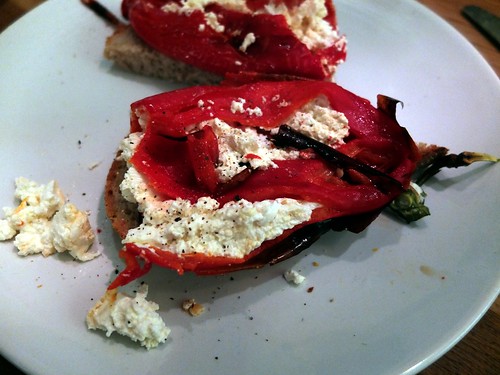
My favourite way to use it right now however is to stuff it into Turkish peppers before slinging them on the BBQ. They are lovely when wrapped up inside a flat bread with a kebab, oozing their creamy centres against the sizzling meat. If you’re up for it, you fly bastards, stuff some green chillies instead.

Labneh Stuffed Peppers Recipe

1 x 500g tub Total yoghurt
Large pinch of salt
About 5 mild green Turkish pepper for stuffing (you could also use the long red Romero peppers if you can’t find the Turkish ones)
Oil
Muslin or a dishcloth for straining

In a bowl mix the yoghurt with the salt. Line a bowl with the muslin or cloth and scrape the yoghurt into it. Tie the top with string or whatever you have and suspend it from something. I used to use a cupboard handle but now I have a very sun filled, hot kitchen and so I hung it in the fridge. Set a bowl underneath to catch the whey. Leave for 5 or so hours. It will be usable but soft after 3. If you want to make balls with it and preserve them in oil then the longer the better as the labneh will need to be fairly firm for rolling.

Cut the tops off the peppers and de-seed them without cutting the sides. Stuff with labneh. Rub with oil, salt and pepper and either grill on a BBQ or underneath a hot grill until charred in places and soft. Serve either in kebabs, or on toast, in pittas…


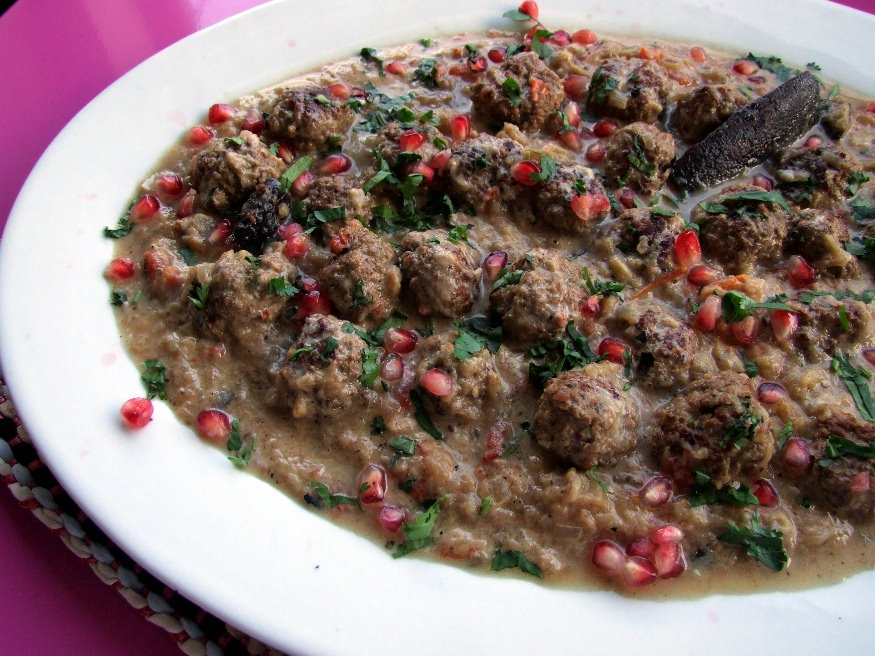
Lamb and Date Meatballs in a Frazzled Aubergine Sauce.

When shiny aubergines are placed over a naked flame, their skins blacken and they collapse inward on themselves with a steamy sigh. Once cooled and split, the inside is gloriously smoky; a total transformation. It is this creamy flesh that blends into dips such as baba ghanoush, but I like to use it as a base for a sauce.

The meatballs are made with lamb, dates and warming spices like cumin and chilli. I’ve nicked a trick from the Italians too and mixed in some breadcrumbs soaked in milk – just a little – so they become light and extremely easy to eat. A swirl of yoghurt and a few pomegranate seeds make this dish pretty. Serve with couscous or bread to absorb the luxurious sauce.

Lamb and Date Meatballs in Frazzled Aubergine Sauce

500g minced lamb
4 dates, pitted and finely chopped
1 heaped teaspoon cumin seeds
1 teaspoon coriander seeds
1 heaped teaspoon hot chilli flakes, or to taste
1 teaspoon dried mint
1 thick slice white bread
Milk (about 4 tablespoons)

For the sauce

4 aubergines
1 large onion, finely chopped
2 cloves garlic, crushed
1/2 400g regular tin chopped tomatoes
2 black cardamom
1 tablespoon pomegranate molasses
1 cinnamon stick
300ml vegetable stock

Vegetable oil, for frying

Pierce the aubergines in several places with a fork, then place directly on the gas ring of the hob, turning occasionally, until black and shrivelled all over. Alternatively, grill them to the same effect.

Remove the crusts from the slice of bread and break into rough pieces. Place in a small bowl with enough milk to mash to a paste.

In a small frying pan, toast the cumin and coriander seeds over a low heat, stirring frequently, until they start to smell fragrant. Take care not to burn them. Grind them in a spice grinder or crush them in a pestle and mortar.

In a large bowl combine the minced lamb, bread paste, ground cumin and coriander, chilli flakes, chopped dates and mint. Season with salt and pepper. Mix well; really , really well. Get in there with your hands and knead the mixture almost like a bread dough. Make sure the dates are well distributed. Roll into walnut sized balls. Set aside on a plate.

Heat 2 tablespoons of vegetable oil in the Le Creuset, and fry the meatballs in batches, 4 or 5 at a time, until golden brown all over. Set each batch aside while you cook the next.

To make the sauce, scrape the flesh from inside the aubergines, leaving behind the blackened skin. Chop roughly. Fry the onion until , cardamom pods and cinnamon stick until the onions are soft and beginning to colour. Scrape up the lovely meaty residues from the pan as you do this. Add the aubergines and garlic. Turn up the heat a little and Cook for about five minutes more stirring.

Add the tomatoes, pomegranate molasses and stock. Put lid on and cook for 45 mins to an hour on low heat. Taste and season. For a thicker sauce, remove the lid towards the end of cooking time to reduce it. Add back the meatballs to heat through.

Scatter with pomegranate seeds and coriander to serve.

It’s National Sandwich week, so obviously I’m all over that like ketchup on a chip butty. Or brown sauce if you’re, you know, NORMAL.

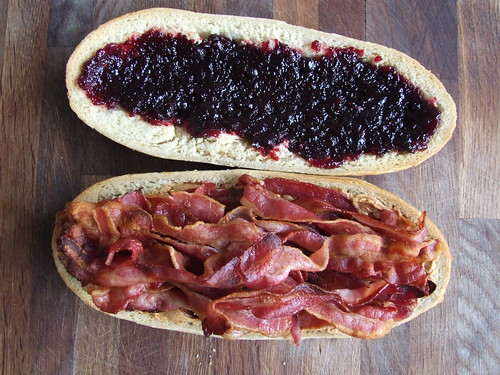
Anyway it seemed only right to honour the week with some sandwich bits and bobs so today I give you a recipe for what is a frankly outrageous piece of work – The Fool’s Gold Loaf. Made famous by Elvis ‘The King’ Presley, and taking its name from the reportedly stupendous price tag of $49.95. The story goes that Elvis would travel miles to eat this sandwich at the restaurant where it was invented, a joint called ‘The Colorado Mine Company’, in Denver. It’s said in fact that Elvis once flew his guests in from Memphis on his private jet just so they could eat it.

In true Elvis style this sandwich is a vision of excess – an entire loaf, hollowed out and filled with a jar (yes a jar) of peanut butter, followed by a jar (yes a jar) of grape jam, followed by a substantial amount (you get the idea) of crisp grilled bacon.

The combinations may sound odd, but the mixture of salty and sweet flavours isn’t that far out there; think bacon and maple syrup on waffles, or salted caramel ice cream. That said, I’ve never known a sandwich to elicit such a wide range of noises from people when eaten – a mixture of ‘mmm this is tasty’ plus ‘wow, this is wrong’ but ‘mmm this is tasty’; once you’ve had one bite, it’s  difficult to resist taking another.

This sandwich serves one, if you’ve the appetite of Elvis. It will serve approximately 8 ‘normal’ people however. Uh-huh.

Fool’s Gold Loaf

1 x approximately 11 x 4” white loaf
450g streaky bacon
250g smooth peanut butter
250g grape, blackcurrant, blueberry or plum jam
Butter, for spreading on the loaf

Preheat the oven to 150C.

Cut the loaf in half lengthways, leaving a little more thickness to the bottom half. Remove most of the crumb from the inside of each half, leaving a thickness of a couple of centimetres (or as much as you like). Spread each half with butter, inside and out.

Place the two halves on a baking tray and bake until toasted and lightly golden all
over (approx. 15 minutes).

While the bread is toasting, grill the bacon until crisp.

Spread the bottom half of the loaf with the peanut butter, then layer on the bacon. Spread the top half with the jam and sandwich together. Cut into slices to serve.

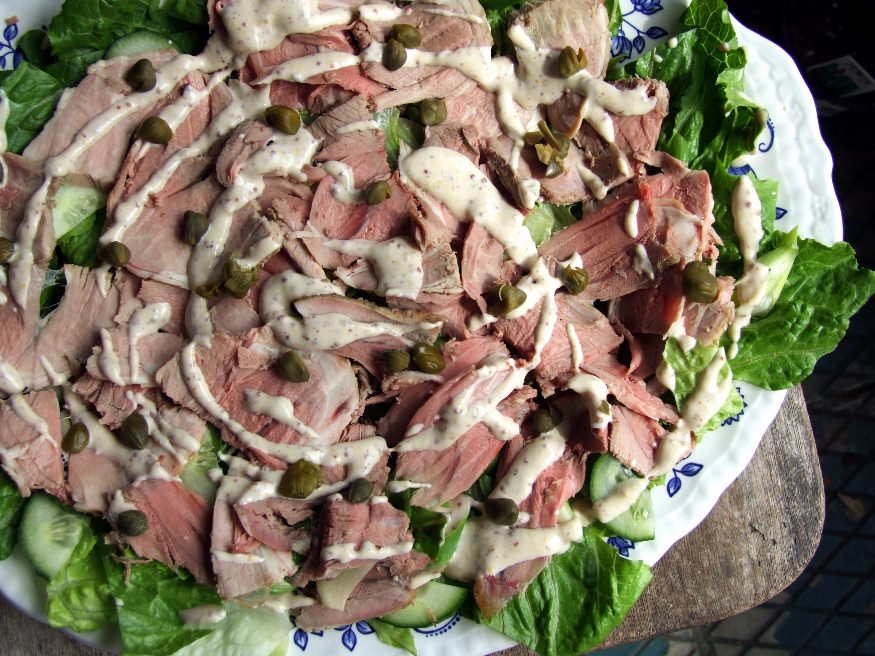
Cold Roast Lamb with Anchovy Sauce

Leftovers are, for me, almost always better than the original dish. Even as a child I always wanted everything cold; steak and kidney pie being my favourite. I remember the highlight of holidays away with a friend’s family being these pre-packed, jellied treats, an anti-dote to the PURE EVIL that we were given to drink (that’s hot Ribena for those who don’t know). Again, I preferred that cold.

This is a rip off of a Simon Hopkinson recipe for cold veal with anchovy sauce and sliced boiled eggs. The salty anchovies work just as well with cold lamb as they do when jimmied into crevices with garlic and rosemary and roasted in a hot oven. Instead of melting away however, here they retain their flavour which, for me at least, is a very good thing.

Cold Roast Lamb with Anchovy Sauce

For the sauce (makes enough sauce for 4 people) 

6 tablespoons mayonnaise
8 anchovy fillets
1 tablespoon wholegrain mustard
1 teaspoon white wine vinegar
Splash of water

Plus the rest…

Sliced cold roast lamb
Lettuce leaves
Finely shredded spring onions
Capers, rinsed

Lay the lettuce leaves on a plate and sprinkle with some finely shredded spring onions. Lay the sliced lamb on top.

Put all the sauce ingredients in a small blender and whizz them up. Taste and adjust the quantities, you may want a little more white wine vinegar for example. Drizzle the sauce over the lamb and dot with capers.

Never have I felt more like a fully fledged member of the Food Tosserati as when I found myself using raw milk from the farmers’ market to make this ice cream, then shortly after seasoning my dauphinoise with penja pepper, before jostling it into the fridge next to the batch of wild garlic pesto I’d made the day before. Oh dear.

Tell you what though, raw milk does taste fantastic. ‘Raw’ meaning unpasteurised. It’s rich and creamy and supposedly has health benefits which are destroyed by pasteurisation. I don’t know the evidence for this and frankly I don’t have time to look so if anyone out there has properly delved into it, I’d be grateful to know the outcome.

What I can tell you is that it makes fabulous ice cream. It was supposed to be prune and Armagnac, but there’s only so far a corner shop in Camberwell can stretch in the booze department, so prune and cognac it was and blimey, was it ever tasty.

I made this for dinner, for the boyfriend’s parents no less. When I took the first mouthful I thought ‘holy shit, this is a bit good’ but obviously kept my trap shut for fear of appearing smug or boastful. So if you want to impress parents or other such important people, and also erm, keep them regular, then make this ice cream.

Prune and Cognac Ice Cream

(fills 2 plastic tubs of the kind that takeaway food arrives in)

20 prunes, pitted and chopped (just chop each into about 3 pieces)
180ml cognac
60ml water
500ml double cream
500ml whole milk
225g caster sugar
6 large egg yolks

Simmer the prunes, cognac and water in a small pan, until 3/4 of the liquid has evaporated. Set aside to cool.

Scald the milk and cream (this means heating it until almost but not boiling, basically when bubbles start to appear around the edge, you’re done). Whisk the egg yolks and sugar together until they turn pale and start to thicken. Continue whisking, and add about 1/3 of the hot milk and cream mixture to the egg mix, then when it is incorporated, add the remaining mixture (again whisking all the time).

Pour the lot into a clean, heavy based pan and cook over a low-medium heat, stirring constantly, until the custard thickens and coats the back of a spoon. You can also test if it’s ready by drawing a line down  the custard on the back of the spoon with your finger. If the line stays, it’s ready. A thermometer makes this even easier. You’ll get the result you want at 80C.

Put the mixture aside in a bowl and add the prunes and any juices. Cover by placing a layer of cling film or greaseproof paper directly on top of the custard, to stop a skin forming. Leave to cool completely, before churning in an ice cream maker, then freezing for an hour or two before serving.

You can also make this without an ice cream maker, but you’ll need to remove it from the freezer every hour or so and either beat it with an electric mixer or hand whisk, the idea being to break up as many ice crystals as you can in order to make it as smooth and creamy as possible.

Stuffed Artichokes

Oxford, despite being a rather famous and much visited city, doesn’t really have many good restaurants. At least, it didn’t when I lived there for a good five years and I haven’t really heard any news to the contrary since. Maybe I’m out of touch.

One diamond in the rough used to be The Magdalen Arms, a pub on Iffley Road, which served food that was everything pub grub should be but rarely is; un-fussed and generous, yet skilfully cooked. I remember a resplendent crab, nothing more than plunged into boiling water and served whole, ready to be worked over, the meat dipped in quivering mayonnaise. We sat in the sunshine and cracked, delved and mined its nooks and crannies for meat, rocking around in our seats on the back of copious amounts of rosé.

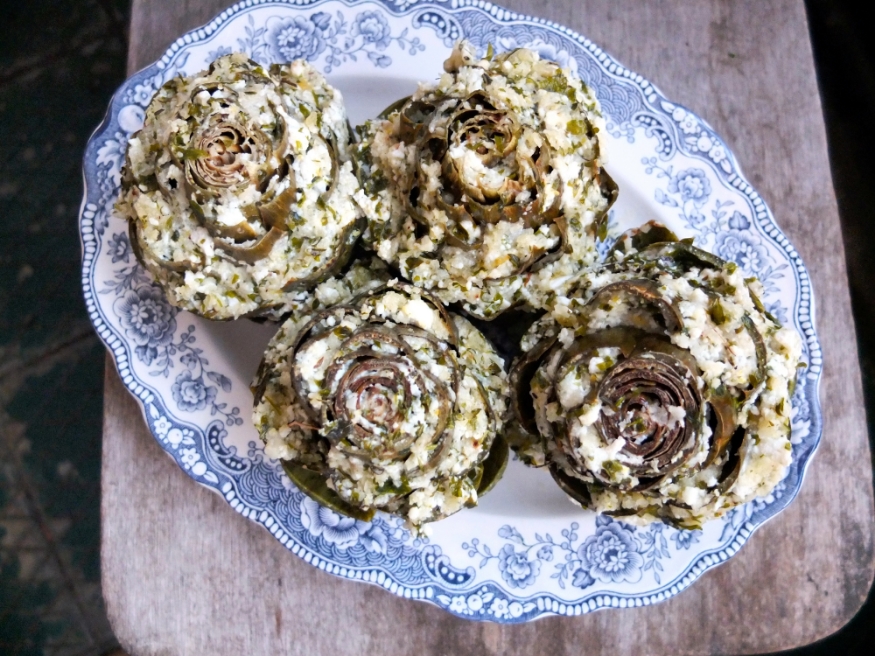
Another highlight was a stuffed artichoke, leaves splayed and crammed fat with goats’ cheese, herbs and breadcrumbs, shiny with olive oil. We teased away the leaves and sucked the creamy, intense stuffing from them. This was probably about 3 years ago and the dish still enters my thoughts occasionally, hence, this recipe.

Once the leaves are sucked clean, there is of course the sweet, soft heart to be had. A lovely, leisurely starter.

Cheese and Herb Stuffed Artichokes

(serves 2-4, depending on appetite)

2 large or 4 smaller globe artichokes
1 thick slice stale white bread, whizzed into breadcrumbs
2 cloves garlic, finely chopped
1 small bunch parsley leaves, finely chopped
125g ricotta and 50g feta OR 175g goats cheese
1 teaspoon dried oregano
Zest of 1 lemon
4 tablespoons olive oil, plus one more for cooking

Snip the tips off the artichokes leaves and stems, turn them upside down and give them a good rap on the counter top to make the leaves splay out a bit. Give them a bit more encouragement to open up using your fingers, then keep them in a bowl of water with a squeeze of lemon juice. This supposedly stops them from going brown, although they always seem to do it anyway.

Prepare the stuffing by mixing everything together and adding some salt and pepper. Stuff the mixture into the gaps between the leaves then arrange the artichokes in a pan where they fit snugly, you don’t want them moving about in there. The advice is not to cook them in a pan made of reactive metal such as iron or aluminium, again because it makes them discolour although again, I find they do anyway.

Fill the pan with water so it comes about a third to halfway up the artichokes and add the other tablespoon of olive oil. Bring to the boil, then reduce to a simmer and put a lid on. Cook for 25 minutes, or until the leaves come away without too much resistance.

Allow to cool for 5 minutes or so, then serve. With napkins. Lots.


Afghan Zamarud

Over the years I have become very interested in the food of Iran, then Georgia, and now Afghanistan. The cuisines all make use of ingredients I am very fond of, such as yoghurt, meats like lamb, fruits such as dates and pomegranate, vegetables such as spinach.

A browse around the bookshelves of Iranian shop/deli Persepolis recently turned up Noshe Djan, an Afghan cook book by a woman called Helen Saberi. Helen has written a cook book of the kind I have increasingly come to love; she married an Afghan man and spent a significant amount of time living in Afghanistan absorbing the culture and cooking the food. She has lived the life of an Afghan and she provides a heartwarming introduction to the Afghani meal time; the book is the kind one can read like a novel. It is genuine, accessible and utterly fascinating.

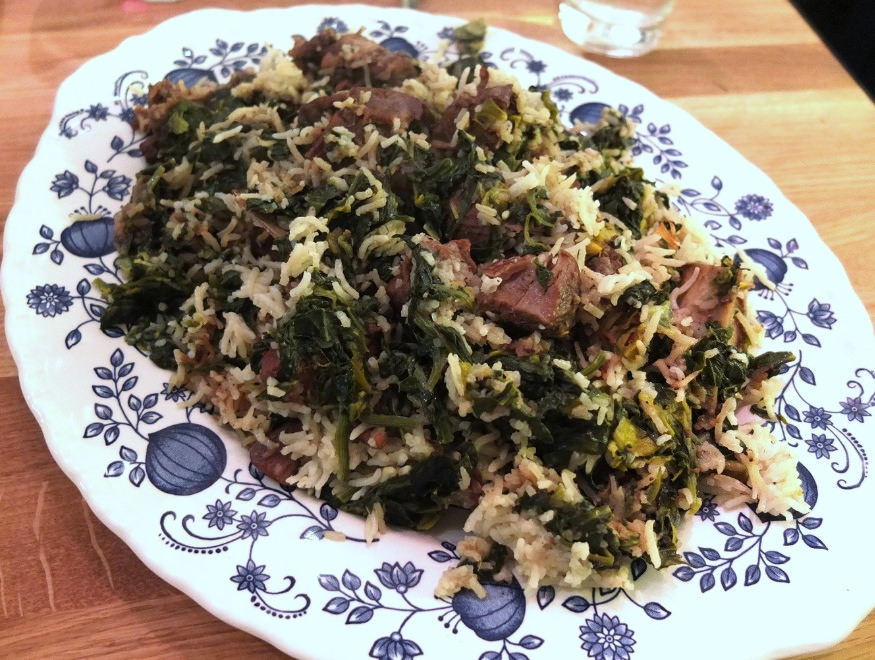
The first recipe I’ve cooked is the amusingly titled ‘sabzi pilau’ or ‘zamarud’, meaning emerald. I say amusing as every recipe like this, which suggests the main ingredient is a vegetable (in this case spinach), then goes on to specify ‘700g of lamb’ or, often, chicken.

It was bloody delicious, although it did take a few hours to cook. Worth waiting for, but anyone who is making this might want to consider doing it on a weekend. Or perhaps you’re smart enough to just read the recipe properly in the first place, unlike me. We ate at 12.30 am. The spice mix makes this interesting – char masala. It is equal parts cinnamon, cloves, cumin and black cardamom. In other spice mixes the stronger flavours like cloves are generally used in smaller quantities, but not here. I also loved the liberal use of black cardamom which I don’t often see; one of my favourite spices, like giant smoky black raisins.

The final pilau was comforting, with the feel of a biryani. I served it with garlic yoghurt (made by blanching some peeled garlic cloves then mixing with lightly whipped, seasoned yoghurt) and an aubergine pickle, which is also worth mentioning. Small aubergines are slit, and then a whole garlic clove placed in each one; when pinched together they look like mussels. The pickling liquid is simple – white vinegar, sugar and green chillies, nigella seeds and fenugreek, the flavour of the latter being particularly suited to aubergines. It has a sort of intriguing musty flavour which contrasts the acidity. The pickled green chillies are obviously a mega bonus too.

Afghan Zamarud

(from Noshe Djan by Helen Saberi)

This recipe serves 4, although if you have other dishes too it could easily serve 6-8. I’d recommend eating it with yoghurt on the side. The lamb can be substituted for a whole chicken, jointed.

450g long grain white rice (basmati preferably)
110ml veg oil
2 medium regular onions, diced
700-900g lamb on the bone, diced (I only used 500g diced lamb shoulder, which was enough. I can imagine goat would also work well)
225ml water
2 teaspoons char masala (to make char masala take equal quantities of cumin seeds, cloves, cinnamon stick and the seeds from inside black cardamom pods and grind them in a spice grinder or pestle and mortar)
450g spinach
110g leeks
2 teaspoons ground coriander (Helen also gives an alternative of dried dill)
1.5 litres water
2 hot green chillies
Salt and pepper

Rinse the rice a few times until the water runs clear and then soak it in fresh water for at least half an hour.

Heat 75ml oil in a pan and fry the onions in it, stirring frequently until soft and golden. Trim excess fat from the lamb pieces, then add it to the pan and continue frying until the meat is well browned. Add the 225ml water, 1 teaspoon of the char masala and salt and lots of black pepper. Bring to the boil, reduce to a simmer and cook until the meat is tender. This takes a couple of hours, FYI, depending obviously on the size of the lamb dice. It’s nice to have big chunks but if you want it to cook faster, cut it smaller.

Prep the spinach by cutting off any large stalks and washing really thoroughly, then chop roughly.

Heat the remaining oil in a large pan and fry the leeks in it, until they are soft and nearly brown. Add the spinach and continue to fry, stirring all the time. When it starts to wilt down and reduce in size, turn the heat down, cover the pan and cook gently until the spinach is completely wilted down and cooked. Add the ground coriander (or dried dill) and some salt and pepper. Cover and cook gently until all the water is evaporated and the spinach soft.

Preheat the oven to 150C/200F/Gas 2

Bring the 1.5 litres of water to the boil and add a teaspoon of salt. Drain the rice from the soaking water and add to the boiling water. Cook for 2-3 minutes, then drain and add to a casserole dish with a tight lid. Add the spinach and meat along with approx 175ml of the juices and the other teaspoon of char masala. Mix this together gently but thoroughly. Put the green chillies on top of the rice. Cover the dish and put it in the oven for about 45 minutes.

After this time, remove the chillies from the top of the rice. Serve the dish on a large platter. As I said, I like it with yoghurt, which I mixed with crushed garlic that had been blanched in boiling water for a few minutes. Garnish the dish with the chillies.

Aubergine Pickle

(from Noshe Djan by Helen Saberi)

This works best with baby aubergines. Helen says that if you can’t get them you can use regular aubergines too, diced. In that case just chuck the garlic cloves in to simmer with the diced aubergine.

450g baby aubergines
110g garlic (basically a garlic clove for every baby aubergine)
1 heaped teaspoon turmeric
2-3 oz fresh green chillies (about 8)
1 tablespoon nigella seeds
1 tablespoon fenugreek seeds
1 teaspoon salt
1/2 tablespoon dried mint
1/2 teaspoon sugar
500ml vinegar
150ml boiled water

Slit the baby aubergines lengthways to the stalk, but don’t separate them. Put one peeled garlic clove inside each as per the picture above.

Fill a saucepan with water and bring it to the boil. Add the aubergines. The water should cover them. They will bob up to the top during cooking, when you will need to push them down again. Inevitably some of the garlic cloves will pop out – don’t worry about it, you can fish them out afterwards.

Simmer gently for five minutes then remove the garlic and aubergines with a slotted spoon. Keep the cooking water. Once they are cool enough to handle, put a layer of aubergines and garlic in a large jar, followed by a layer of chillies and repeat until both are all used up.

Mix together the vinegar, sugar, salt, fenugreek, dried mint and nigella seeds plus 150ml of the cooking water. Pour over the aubergines. Seal with a lid.

I ate mine after about 3 days and they were lovely. Helen doesn’t specify how long they should be left before eating.

Pkhali

You can make pkhali with any vegetables really, and the Georgians also commonly use beets, which make a lovely colour contrast against the spinach if you’re planning your own supra.

This mixture improves the longer you leave it in the fridge and I’d say it will keep for up to a week.

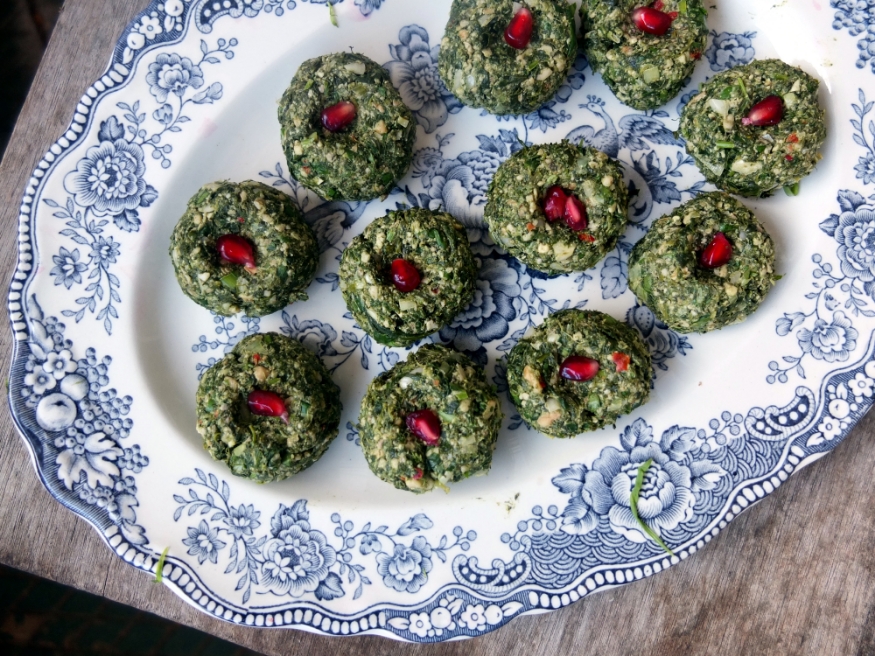
Georgian Spinach Pkhali

(adapted from Saveur)

600g spinach (the proper, big ballsy stuff; I’m done with baby spinach)
180g shelled walnuts
1 generous handful coriander leaves
1 generous handful tarragon leaves
1/2 teaspoon ground turmeric
1/2 teaspoon ground fenugreek (I crushed the seeds in a pestle and mortar)
2 tablespoons red wine vinegar
3 spring onions
1 heaped teaspoon chilli flakes (I used Turkish)
1 pomegranate, for garnish

Chop the stalks off the spinach and then wash the leaves really well. Chuck it into a large pan while it is still wet, put a lid on and set it over a low heat. Let it slowly wilt down, stirring every now and then, until it is all wilted. Allow it to cool completely (the easiest way to do this is to spread it out on a plate). When cool, squeeze out as much water from the spinach as possible. You will be amazed at the amount of water that has come out and by how much the spinach is now reduced in size.


Pound the walnuts in a pestle and mortar until they are more or less all crushed to a powder (a few chunks here and there are fine). Mix the walnuts with the spinach and all the other ingredients, plus plenty of salt (more than you think necessary) and pepper.

Mix really well, cover and refrigerate overnight. The next day, shape into balls about the size of a golf ball and make a small indent in the top of each one with your fingertip. Place a pomegranate seed in each. Serve with bread or toast for spreading. Ideally khachapuri.

Whole cauliflower tagine

Diet? January? Pah! I’m sorry but we need insulation during this snowy month and I’m all about blubbering up. Okay I’m actually going to join the gym as soon as I get paid. I’ve spent the past couple of weeks eating things like langos, an Italian feast and my own body weight in melted cheese at Forza Winter. Oh, and after Forza Winter I ordered a pizza at 2am. And then finished it for breakfast. And then and then and then and then. So you see I need to cut down on the cheese intake and up it on the veg side of things, which is how this cauli tagine came about.

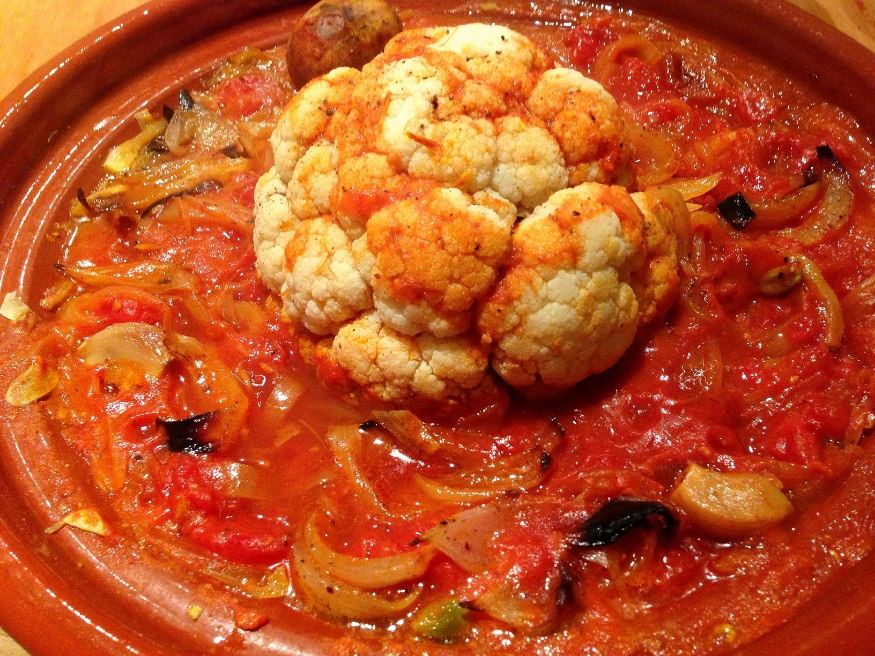
The cauli is one of my favourite vegetables, and the once poor, unloved brassica is now apparently back in favour. I’ve wanted to steam one whole for ages and it seemed perfect for the tagine; it would cook gently inside, picking up all the spiced aromas over and hour or so. It would also look pretty snazzy on the table.

I streaked the top of the brain-like cauli with saffron steeped in water; a flavour I used to hate with a passion. I found it soapy and unpleasant. The most expensive spice in the world? Didn’t get it. Well, I did; it’s very laborious to harvest of course but still. I’ve come to like it through cooking Iranian food and although I still wouldn’t count it among my favourite flavours, it sure does look purdy and I find it fragrant when used with appropriate modesty.

The cauli was cooked in a rich, thick sauce of onions, garlic, tomatoes and a few dried apricots, with a dried lime for a sour note; dried limes are amazing, when plucked from the bag they smell like lime sherbet. Spices went in, whole and ground; the onions taking on a beautiful amber hue from the turmeric.

It took rather longer to cook than I’d imagined, which has been my experience with the tagine thus far. I predicted an hour – it was more like one and a half. We ate it with a minty cous cous and a yoghurty drizzle effort which was basically yog mixed with diced pickled lemon and some garlic, briefly simmered to take the fiery edge off.

A seriously satisfying dish and, all importantly, insulating. I felt sufficiently sleepy, particularly when curled up with a glass of red and some Attenborough on the laptop. In bed by half past nine. Result.

Whole Cauliflower Tagine

(serves 4, I’d say)

1 whole cauliflower
2 tins chopped tomatoes
2 large onions, thickly sliced
4 cloves garlic, peeled
1 cinnamon stick
6 cardamom pods (I like cardamom, a lot)
1 teaspoon cumin seeds
1 teaspoon coriander seeds
1 scant teaspoon ground turmeric
1 dried red chilli
Pinch saffron (optional and like, totally not necessary)
1 dried lime
Handful dried apricots (preferably Persian)

Start by heating up the tagine slowly. Add some oil, then sling in the onions. Let them cook slowly for about 10 minutes. Toast the cumin and coriander seeds in a dry pan until fragrant, then crush in a pestle and mortar with the dried chilli. Add to the tagine with the other spices and the garlic. Continue cooking for a further 10 minutes or so. Add the tomatoes and dried lime, plus the apricots. Let the sauce cook down for 20-30 minutes until it’s starting to look all thick and gooey and lush. Season the sauce with salt and pepper.

Remove all the leaves from the cauliflower then trim down the base so it’s all nice and neat. Place the cauli on top of the sauce. If you want to use the saffron, steep it in a little boiling water for 5 minutes then steak across the top of the cauli. Put the lid on and cook on a gentle heat for about 1 hour to 1.5 hours, depending on the size of your cauli. When it’s tender, it’s cooked.

Serve with herby cous cous (I used mint and parsley) and yoghurt with chopped preserved lemons and garlic which has been simmered to take the edge off, then crushed.

Langos

So I’m having dinner with my Hungarian friend Gergely and he’s waving his arms excitedly in the air, getting all nostalgic for langos. During the conversation I get the impression very quickly that Hungarian food is all about insulating; it’s cold there in the winter, innit. Although apparently, they eat it on the beach too. Basically a lot of the food seems to be rib sticking, fatty, carb loaded and in this case, deep-fried. I am instantly all over it like a particularly vicious rash.

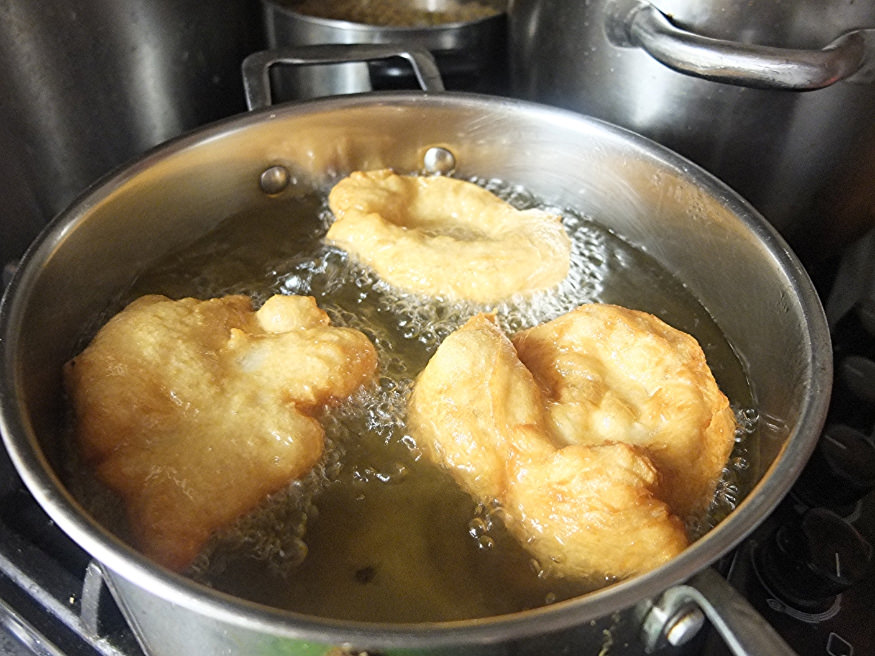
On Sunday Gergely came to my house and taught me how to make langos and it was brilliant. He freaked me out by managing to get the dough to rise super fast in my rather cold kitchen, then we made sort of cowpat sized discs of dough and plunged them into hot oil. A couple of minutes each side and they emerged golden and sizzling; is there anything more appealing than freshly fried dough? No, no there is not.

We’re not done yet though, because here comes the most important thing about langos – garlic water. The garlic water makes the langos special. It’s officially my new favourite thing and I have a lot of favourite things on the go right now. Basically you just get an absolute shit load of garlic and whack it in a jar with, you’ve guessed it, some water. Oh and a little bit of oil. You mix it together and the garlic kind of mellows but at the same time stays er, really strong. Yeah, that makes sense. Anyway so you brush the freshly fried langos with the garlic water and the intensity of perfume created by the heat meeting the garlic is incredible.

Then it’s time to smear that dough with sour cream. I am assured that Hungarian sour cream is far superior and now of course I long for it. I had to make do with some regular stuff from Tesco Metro. Still, sour cream it was. To finish the langos, grated cheese. Yep. Oh and it absolutely has to be the shittiest cheapest most poorly produced ready grated cheese you can find, apparently. Gergely was very adamant about this. We bought some kind of basic stuff from Tesco and he instantly pronounced it ‘too good’.

Langos

Unsurprisingly I instantly fell in love with langos. It’s deep fried dough covered in garlic, sour cream and cheese FFS. We washed it down with Unicum which is like Hungarian Fernet Branca. I’d planned dinner afterwards. It didn’t happen. Gergely and his girlfriend rather impressively went straight on to dinner at Koffman’s. Respect.

Langos is the kind of food we should all be eating in January. Sod the diet, it’s cold and the Hungarians really know how to do food that keeps you warm.

You will however stink of garlic for 2 days.

Langos Recipe

(makes loads)

1kg flour
2 sachets instant yeast
1 pint luke warm water
2 tablespoons sugar

Mix the sugar, yeast and water in a jug. Wait 5 minutes or so until the top is frothy, then mix with the flour to make a semi soft dough. Gergely did this with his hands. The dough should be really sloppy.

When the dough has doubled in size, oil a piece of foil, then add a drizzle of oil around the edges, which makes the dough come out of the bowl really easily (it is very sticky and won’t come out otherwise). Turn it out onto the foil, cut pieces and make little rounds, which are thinner in the middle.

Deep fry the fuckers.

For the garlic water and to assemble:

Mix about 10 cloves of garlic with a jam jar of water and a splash of oil. Leave for a couple of hours to infuse.

Thin the sour cream by whipping it with a bit of water.

To assemble, douse the langos with the garlic water, spread on sour cream and top with shitty grated cheese.

We did some crazy pimping with a bit of smoked salt and some fennel seeds, admittedly after we’d started on the Unicum.

Peckham Goat Tagine

Tagines have always been something I’ve viewed as having great potential to be really tasty, but I’ve never eaten a good one. What I imagined in my head to be a thick, rich, aromatic stew with complex flavours always arrived as a thin, watery bowlful bearing way too much dried fruit.

Because I am a spoiled and lucky girl, I received a magnificent tagine for Chrimbo; a chance to turn things around and make the tadge I’ve always wanted, Peckham style.

The tagine is heated on a little metal thing that looks like a ping pong bat with dimples in it, which helps to distribute the heat evenly across the base. It’s important that the tagine is heated slowly, otherwise it will crack and spoil all your fun before you’ve started.

The base was thickly covered with a bed of onions, the idea being that they would cook down, becoming silken and lush and absorbent of everything above. This being Peckham (bruv), the meat had to be goat, which is very easy to come by here. Its ballsy mutton like flavor is perfect (you could obviously substitute mutton if you can find goat) and it loves long cooking to become properly tender. For veg, some of those little white baby aubergines, which also need a good simmering into submission (they remain stubbornly bitter otherwise) and some small turnips, diced.

For the fruit, which for me is potentially the making but most commonly the breaking of a good tagine, I bought dried fruits from Persepolis, ending up with a kind of Moroccan/Persian hybrid recipe. There are many similarities between the cuisines. In went a dried lime, which the Iranians add mostly to stews where they bob about, gradually releasing a flavor which is like a lime essential oil, emerging at the end shriveled and spent. Apricots went in too, but not those horrible overly sweet and sulphurous supermarket ones but fragrant perfumed Persian fruits. A few scarlet barberries flecked the top, adding sourness, like tart cranberries.

For heat, I couldn’t help whacking a scotch bonnet in. I’m sorry. If I didn’t I’d be betraying Peckham. It was left whole though and just pierced, to contain heat but leach flavour. Having impulse bought a bag of African hot peppers, a couple of those went into a spice paste with loads of garlic, two types of paprika and a shed load of ras el hanout. It could have blown our heads off but didn’t; a bit on the hot side for a tagine, but with an enjoyable slow build.

After three hours of simmering and steaming what emerged was the tadge I’d always wanted; deep and complex, sweet then spicy then sour, lips were sticky from slow cooked onions and goat fat. A scattering of mint and spring onion freshened things up at the end.

This is, as you would imagine, even better the next day and again the day after that. I served it with flat bread and Sally Butcher’s Borani-ye Esfanaj (spinach with yoghurt – from Persia in Peckham), which is one of my favourite yoghurty arrangements of all time.

Peckham Goat Tagine

(serves 6)

500g diced goat meat (or mutton)
4 small turnips, peeled and cut to the same size as the aubergines
6 small white aubergines, halved
3 onions, sliced
1 scotch bonnet chilli, left whole but pierced
250ml water
1 dried lime
5 dried apricots
1 scant tablespoon barberries
Mint leaves, finely sliced
1 spring onion, finely sliced

For the paste

5 cloves garlic
1 teaspoon salt
2 African hot pepper dried chillies (optional)
2 tablespoons ras el hanout
1 teaspoon sweet paprika
1 teaspoon smoked paprika (smoky paps)
1 tablespoon water

Ideally I would have marinated the goat overnight in the paste then added it straight to the tagine without browning. I didn’t because I wasn’t organised enough so I’ve set out the method below as I cooked it.

Start by heating the tagine slowly. Add some olive oil, the onions and scotch bonnet chilli. Let the onions cook down gently while you brown the meat.

Cover a plate with flour and season it with salt and pepper. Dust each cube of the goat meat in it. Heat a frying pan and add some oil. Brown the meat on all sides. This will need to be done in several batches. Add this to the tagine, followed by all the other ingredients, including the paste. Season with salt and pepper and cook on a lowish heat for three hours, stirring every now and then after the first hour or so. After two hours, I’d advise you pick out the scotch bonnet chilli, because it’s only a matter of time before it bursts and you get a lot more heat than you bargained for.

Scatter over the mint and spring onion and serve with plenty of flat bread for dipping.